

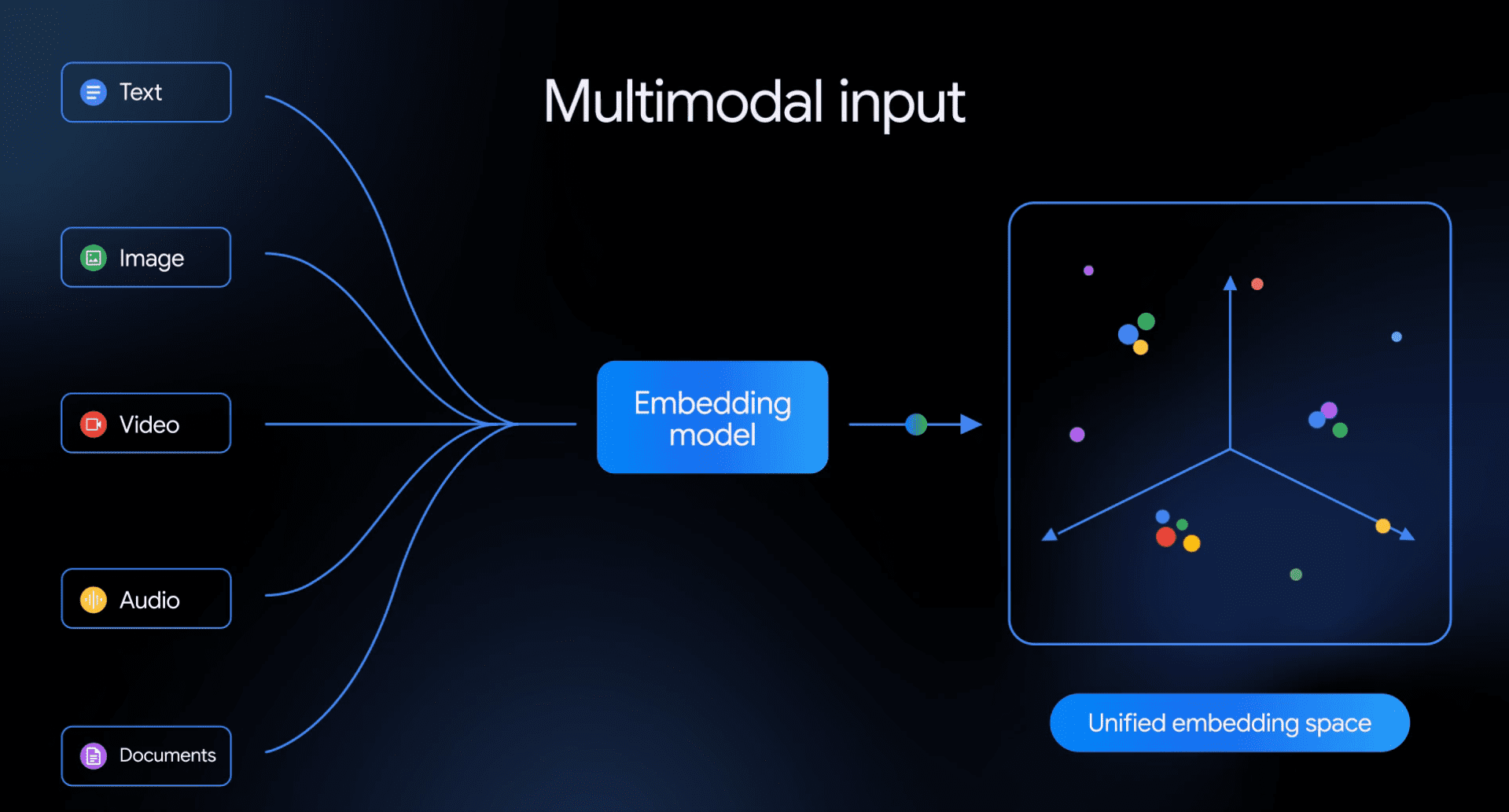
Google has officially launched gemini-embedding-2-preview in public preview, marking the arrival of its first natively multimodal embedding model. Available via the Gemini API and Google Cloud’s Vertex AI, this model maps text, images, video, audio, and documents into a single, unified embedding space.
By capturing semantic intent across more than 100 languages, it establishes a new standard for Retrieval-Augmented Generation (RAG) and complex data analytics. Here is a comprehensive breakdown of what builders, data engineers, and AI developers need to know about integrating this new powerhouse into their tech stacks.
The Multimodal Breakthrough: Native Interleaved Data Processing


Historically, developers relied on disparate text, vision, and audio models to build complex retrieval pipelines. Gemini Embedding 2 changes the game by natively understanding interleaved input. This allows you to pass multiple modalities—such as an image paired with descriptive text—in a single request to capture highly nuanced semantic relationships.
The model boasts significant contextual limits across a wide variety of data types:
- Text: Supports a massive context window of up to 8,192 input tokens.
- Images: Processes up to 6 images per prompt (PNG and JPEG).
- Video: Embeds up to 120 seconds of MP4 or MOV video (no audio) or up to 80 seconds with audio. It features advanced audio track extraction, interleaving audio seamlessly with video frames.
- Audio: Natively ingests up to 80 seconds of audio (MP3, WAV) without requiring intermediate text transcriptions.
- Documents: Directly embeds PDFs up to 6 pages, processing visual elements while simultaneously performing OCR on the text.
Controlling Costs with Matryoshka Representation Learning (MRL)
Storage and compute costs in vector databases are critical considerations for enterprise AI. Gemini Embedding 2 addresses this through Matryoshka Representation Learning (MRL)—a technique that “nests” the most vital information in the initial segments of the vector, allowing for dynamic scaling.
While the model defaults to a rich 3,072-dimensional vector, developers can use the output_dimensionality parameter to truncate output to as small as 128 dimensions.
Developer Note: While Google recommends 3072, 1536, or 768 dimensions for the best performance-to-storage balance, remember that truncated vectors are no longer normalized. You must manually normalize these embeddings to accurately measure cosine similarity for downstream tasks.
Optimizing RAG Pipelines with Task Instructions
To maximize retrieval accuracy, the Gemini API accepts custom task instructions. These optimize embeddings for specific use cases, ensuring the vector space is organized according to the developer’s goal.
When building search infrastructure or RAG systems, use the following parameters:
SEMANTIC_SIMILARITY: Best for duplicate detection or clustering.RETRIEVAL_DOCUMENT: Used for indexing files in a knowledge base.CLASSIFICATION: Optimized for sentiment analysis or intent categorization.YoutubeING: Tailored for finding the best response to a specific query.
Real-World Performance & Case Studies
Early access partners have reported significant efficiency gains by migrating to Gemini Embedding 2:
- Sparkonomy (Creator Economy): Reduced latency by 70% by eliminating intermediate LLM inference steps. Native multimodality doubled their semantic similarity scores for text-to-video pairs, jumping from 0.4 to 0.8.
- Everlaw (Legal Tech): Improved precision across millions of legal records, enabling novel search functionalities for visual evidence during litigation.
- Mindlid (Wellness): Achieved a 20% lift in top-1 recall by embedding conversational memories alongside audio and visual biometric data.

Migration and Integration: What You Need to Know
Gemini Embedding 2 is currently available in the us-central1 region on Vertex AI. It offers out-of-the-box compatibility with major vector databases and frameworks, including:
- Databases: ChromaDB, Qdrant, Weaviate, Pinecone, and Vertex AI Vector Search.
- Frameworks: LangChain and LlamaIndex.
⚠️ Critical Migration Warning
The embedding space of gemini-embedding-2-preview is completely incompatible with the legacy gemini-embedding-001 model. Vectors from different versions cannot be compared; a full re-embedding of your existing dataset is required to upgrade.
Pro-Tip: For large-scale data migrations, use the Gemini Batch API. It provides significantly higher throughput and a 50% discount compared to standard per-request pricing.