
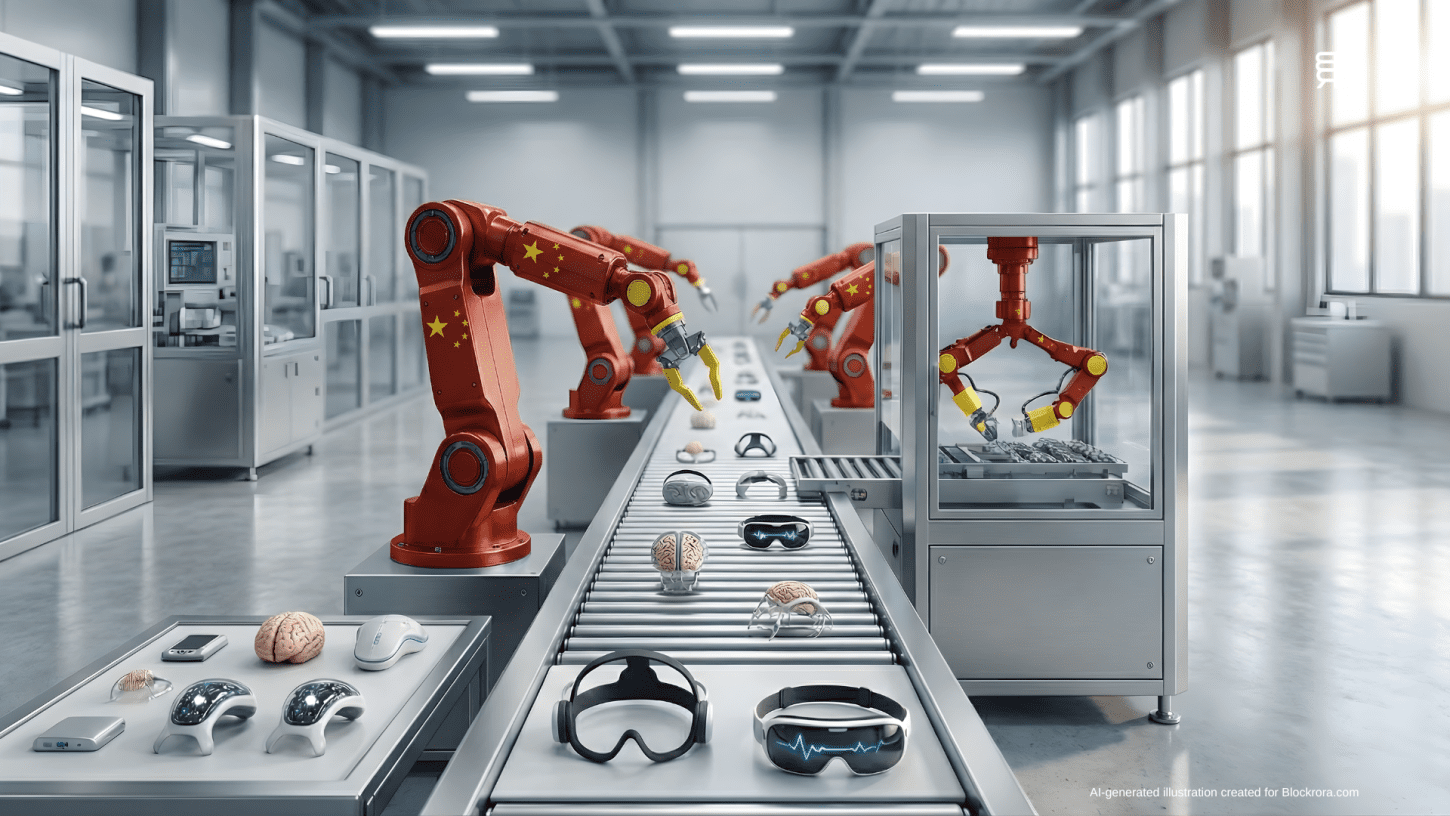
China has officially transitioned its Brain-Computer Interface (BCI) industry from a scientific curiosity into a high-stakes commercial race. Under a newly solidified national roadmap, the country aims for total supply chain dominance by 2030, backed by an 11.6 billion yuan ($165 million) brain science fund unveiled in late 2025. This strategic shift marks a move beyond experimental research toward the mass-market integration of neural technology into the national healthcare and AI ecosystems.
China’s National BCI Strategy: The Shift from Industrial Dominance
From Lab to Life: The Human Impact of Neural Integration
While Western developments often focus on high-profile feasibility trials, China’s BCI sector is scaling through its vast clinical infrastructure. The “human element” is no longer theoretical; companies like NeuroXess have already demonstrated successful wireless control in paralyzed patients. In December 2025, NeuroXess completed China’s first implantation of a battery-integrated brain chip, allowing a paraplegic patient to achieve “mind control” of digital interfaces just five days after surgery.
“We are seeing the bridge between carbon-based and silicon-based intelligence being built in real-time,” says Phoenix Peng, CEO of Gestala. “This is not just about medical recovery; it is about the fundamental evolution of how humans interact with the digital world.”
Invasive vs. Non-Invasive: The Competitive Landscape
The Chinese market is diversifying its technical approach to capture both medical and consumer segments:
- Invasive Solutions: NeuroXess is refining high-bandwidth implants that use a flexible “polyimide and metal mesh.” Unlike Neuralink, which pierces brain tissue, this mesh sits on the surface, achieving data rates of 5.2 bits per second while reducing long-term injury risks.
- Ultrasound Alternatives: Gestala is pioneering ultrasound-based BCIs. These offer a “middle path”—providing higher data resolution than wearable headsets without the risks associated with invasive brain surgery.
- Wearable Scaling: BrainCo, which recently filed for a Hong Kong IPO, has moved into mass production of bionic limbs, targeting the millions of citizens requiring neural assistance.
How is Regulation Driving BCI Market Maturity?
Substance in the BCI sector is found in the administrative details of policy. While preliminary standards were released in September 2025, the “Medical Device Terminology for BCI Technology” (Standard YY/T 1987-2025) formally entered enforcement on January 1, 2026. This provided the legal foundation for the National Medical Products Administration (NMPA) to put BCI devices on a “regulatory fast track.”
Furthermore, provinces like Sichuan and Zhejiang have already set official pricing for BCI medical services. By integrating these procedures into national health insurance, China is ensuring that the technology is not a luxury for the elite but a subsidized medical standard. This creates a feedback loop of data and refinement that Western firms, currently navigating more fragmented insurance landscapes, may struggle to match.
Strategic Outlook and the 2030 Roadmap
The goal is no longer just “catching up.” The Ministry of Industry and Information Technology (MIIT) targets 2027 for a complete “standards system” and 2030 for the emergence of two to three “world-class” BCI enterprises. With over 200 relevant enterprises already active across 25 provinces, the focus has shifted irreversibly from prototype demonstrations to scaled commercial delivery.