
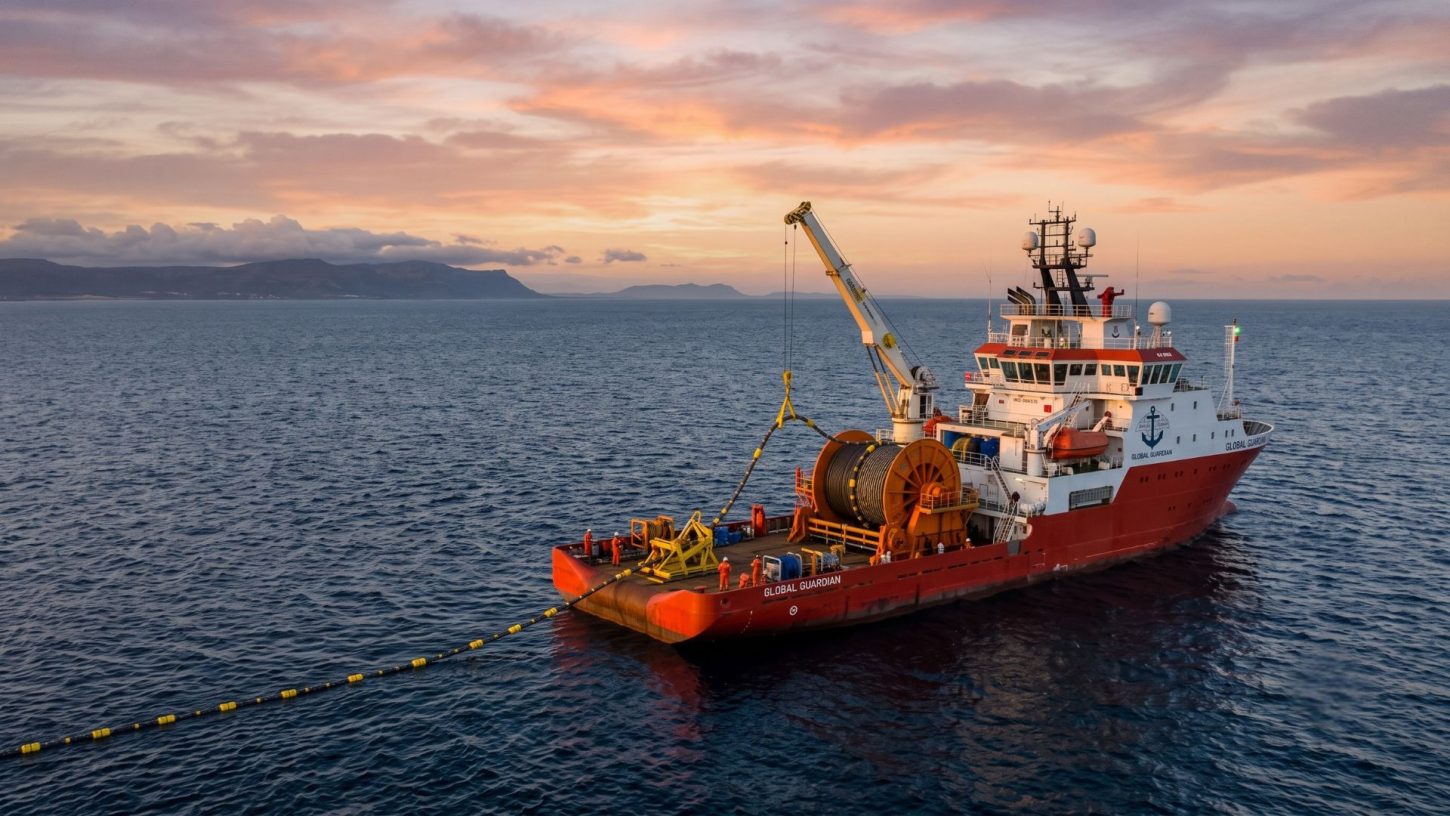
When you send a WhatsApp message, stream a video, or execute a crypto transaction in Africa, your data doesn’t travel through the air. Instead, it moves at the speed of light through a vast network of fiber-optic cables resting quietly on the ocean floor.
But what happens when those cables break?
For the entire African continent, the answer to that question relies almost entirely on just one aging vessel: the Léon Thévenin.
A landmark report by the International Advisory Body on Submarine Cable Resilience (IAB), jointly established by the UN’s International Telecommunication Union (ITU) and the International Cable Protection Committee (ICPC), has sounded the alarm on this fragile setup. Africa’s digital backbone is growing rapidly, but its safety net is stretched to a breaking point.
The Massive Job of a Single Ship
Though the IAB report refers to it simply as the region’s “only permanently stationed repair vessel,” industry insiders know it well. Stationed in Cape Town, South Africa, the Léon Thévenin is a legendary cable-laying and repair ship.
Whenever an undersea landslide, a dragged ship anchor, or a commercial fishing net snags a cable off the African coast, this lone guardian is summoned to fix it.
To understand how risky this single-ship dependency is, you only have to look at a map. If a cable snaps near Dakar in West Africa while the Léon Thévenin is busy repairing a line in Mombasa, East Africa, the ship has to travel over 10,000 kilometers just to reach the site. That is a transoceanic journey comparable to sailing from Shanghai to Los Angeles, all while millions of people and businesses wait in digital darkness.
A Global Imbalance
The vulnerability of Africa’s internet is part of a much larger global disparity. The IAB report reveals a stark “geographical and institutional imbalance” when it comes to maritime repair infrastructure:
- Asia-Pacific and North America/Europe each host about 40% of the world’s active cable repair vessels.
- Africa, the South Atlantic, and the Pacific Islands share just 13% of the global fleet.
- The South Indian Ocean and the southeast Pacific have zero permanently stationed repair ships.
Compounding the problem, the global fleet is aging. Older vessels spend more time in dry-dock for maintenance, reducing their availability by 15% to 20% each year. Replacing them is incredibly expensive, with new purpose-built ships costing between $100 million and $150 million (up to R2.5 billion).
Because building and operating these ships is so costly and the lucrative market for laying new cables often pulls existing vessels away from maintenance work, fleet renewal has been slow. While the ship’s owner, Orange Marine, ordered two new hybrid-powered ships in late 2025 to replace the 43-year-old Léon Thévenin, they aren’t expected to be delivered until 2028 and 2029.
The Staggering Cost of Offline Life
Undersea cable breaks aren’t just an inconvenience; they are economic disasters.
- In March 2024, four major subsea cables were severed simultaneously off the coast of West Africa, crippling connectivity across 12 countries.
- In Nigeria alone, that single outage caused an estimated $590 million (approx. R9.7 billion) in economic losses over just four days.
- In 2020 and 2023, underwater rockfalls in the Congo Canyon throttled South African internet, disrupting financial markets, cloud services, and cross-border data flows.
With climate change increasing the likelihood of underwater landslides near major river systems, the threat to these cables is only rising.
South Africa: A Masterclass in Fast Response
While the overall picture looks precarious, the report highlights a major bright spot: South Africa’s remarkable efficiency.
When a cable breaks, the clock starts ticking. Globally, the median time it takes to get a repair ship mobilized after a fault is 8 days, with the average dragged out to over 22 days due to regulatory red tape.
South Africa, however, is the fastest responder in the world, taking an average of just 1.95 days to mobilize a ship.
The country achieves this world-class speed by keeping cable depots close at hand and implementing pre-authorisation agreements. By slashing administrative delays and streamlining the permitting process for repair crews, South Africa keeps the Léon Thévenin ready to sail at a moment’s notice. Additionally, Google’s Equiano cable, which landed in Melkbosstrand in 2022, was praised by the IAB as a prime example of open-access infrastructure that lowers regulatory and certification barriers.
Building a More Resilient Future
If there is one key takeaway from the IAB’s report, it is that Africa cannot afford to rely on a single ship forever.
While network operators and ISPs have gotten incredibly good at rerouting traffic through alternative paths when a break occurs, true digital sovereignty requires deeper investment. The catastrophic financial losses of major outages far outweigh the cost of building redundant cable routes and backing more repair ships.
Until more vessels join the fleet, Africa’s connection to the global digital economy rests in the hands of a dedicated crew aboard a single ship in Cape Town, waiting for the next call to save the continent’s internet.