
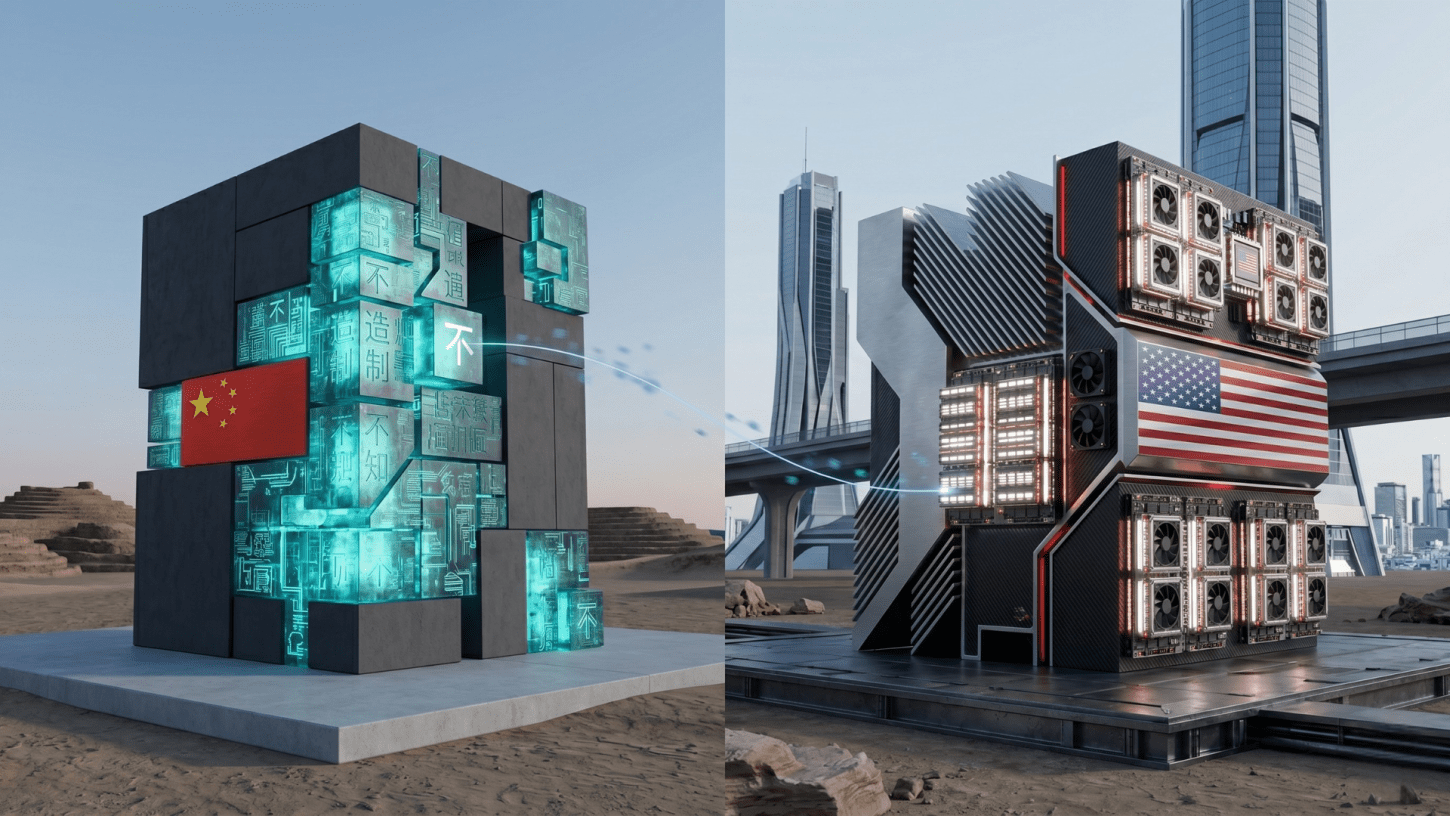
The global superpower rivalry over Artificial Intelligence has officially spilled onto the trading floor. A new front is opening up in the race to financialize artificial intelligence, and Washington and Beijing are building two completely incompatible financial systems to do it.
As the tech sector scrambles to handle runaway enterprise AI expenses, a structural split has emerged: exchanges in the United States are moving to commoditize the hardware behind AI, while China is attempting to commoditize the actual software output.
Hardware vs. Output: The Strategic Rift
In the US, major financial institutions like the CME Group and the Intercontinental Exchange (ICE) are aggressively preparing to launch GPU compute futures. These financial instruments are tied directly to the cost of renting raw data center hardware, the physical Nvidia chips, and server racks that train and deploy Large Language Models (LLMs). The US thesis is straightforward: financialize the infrastructure chokepoint.
China is taking a fundamentally different path. The Shanghai Futures Exchange (SHFE) is quietly designing futures contracts tied directly to AI tokens.
| The Two Paths to AI Financialization | |
|---|---|
|
UNITED STATES (CME Group / ICE Approach) |
CHINA (SHFE Approach) |
| • Focus: Infrastructure | • Focus: Consumption |
| • Unit: GPU-Compute Hours | • Unit: Inference Tokens |
| • Hedging: Cost of hardware | • Hedging: Cost of output |
For clarity, these are not blockchain-based crypto assets or DeFi protocols. In the context of generative AI, a “token” is the foundational atomic unit of information, the raw material or chunks of characters that an LLM processes and generates every time a user inputs a prompt.
By treating these output units as a tradable commodity, China is attempting to create “crop insurance” for the digital age, allowing enterprises to lock in fixed costs for AI consumption before prices experience wild swings.
China’s Exploding Token Demand
The urgency behind Beijing’s financial engineering is driven by a massive explosion in domestic demand. According to data tracking the industry, daily AI token usage in China has experienced a staggering 1,000-fold surge since the beginning of 2024. By the end of March 2026, domestic consumption surpassed a massive 140 trillion tokens per day.
This vertical demand curve has heavily strained China’s computing infrastructure. Severe computational power shortages have already forced several prominent Chinese AI developers to ration user access and limit API availability.
Because demand is outpacing local data center capacity, the pricing of AI services has become highly volatile. A centralized futures market would give multi-billion dollar tech companies a clear mechanism to manage their budgets against these erratic operational spikes.
The Geopolitical Stakes
The divergence between a US market priced in “GPU-hours” and a Chinese market priced in “inference tokens” means that multinational corporations may soon find themselves trapped between non-interoperable hedging tools.
The move highlights that the AI race is no longer just about who builds the smartest model or manufactures the fastest semiconductor; it is about who establishes the global financial standards, indices, and pricing mechanisms for the next century of tech infrastructure.
The strategic importance of this financial architecture was underscored by inside sources tracking the development. Speaking on the condition of anonymity, a source familiar with the matter told Reuters that the Shanghai Futures Exchange’s product research is still in its preliminary phases and is being driven directly by the intensifying AI rivalry with the United States.
With local brokerages estimating that a formalized compute or token derivatives market could debut within three to five years, Beijing is under immense pressure to establish its benchmarks before Wall Street locks in global dominance.