
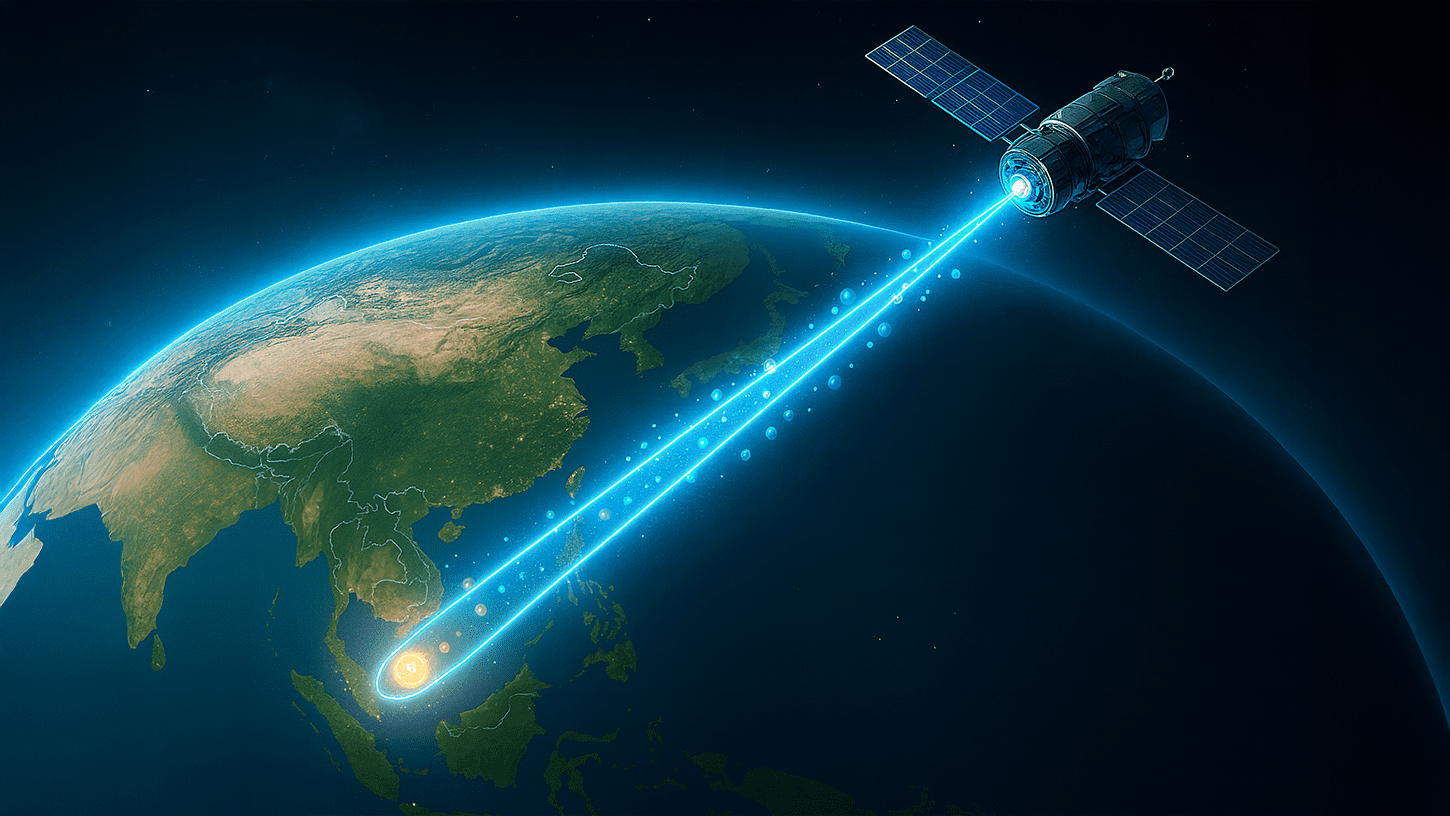
In a record-setting achievement for science and technology, China and South Africa have connected the Northern and Southern Hemispheres with a 12,900km quantum communication link, the longest and most secure of its kind in the world.
Completed in October 2024, the project marks multiple firsts, including the first quantum satellite link in the Southern Hemisphere and the first secure quantum connection bridging the Northern and Southern Hemispheres. For comparison, the previous record was 7,600km and restricted entirely to the Northern Hemisphere.
What Makes This Link Different?
The achievement relies on Quantum Key Distribution (QKD), a technology that doesn’t just rely on complex mathematical encryption like current systems do; it secures communications using the fundamental laws of physics.
Here’s how it works:
- Tiny Light Particles (Photons) are sent from a satellite to a ground station.
- If an eavesdropper tries to intercept them, the photons’ state changes, a phenomenon known as the observer effect, while alerting both sender and receiver.
- Due to the no-cloning theorem, these photons can’t be perfectly copied, ensuring any hacking attempt is detectable.
- Only undisturbed photons are used to create the encryption key.
This means that, unlike conventional encryption, the security here is future-proof; even quantum computers won’t be able to crack it.
How the Record Was Set
The team of researchers used a low-Earth-orbit microsatellite named Jinan 1 to send photons to a portable optical ground station in South Africa.
- The ground station featured a powerful telescope and specialised detectors to capture and measure the signals.
- The secure link was completed during a single satellite pass, delivering 1.07 million bits of ultra-secure encryption key data.
Why It Matters For Tech, Blockchain, and Global Security
This isn’t just a milestone for quantum physicists; it’s a breakthrough that could reshape global industries.:
- Foundation for a Global Quantum Internet
- This link is a vital step towards a future where nations are connected via a quantum-secure network, immune to interception and hacking.
- Next-Level Security for Sensitive Industries
- Governments, militaries, financial institutions, and blockchain networks could one day send information with near-absolute security, safeguarding everything from defence data to cryptocurrency transactions.
- Overcoming Distance Limits
- While fibre-optic-based quantum links suffer from signal loss over long distances, satellites largely bypass these problems, enabling secure communication across continents.
- South Africa’s Quantum Debut
- By partnering with China on this record-breaking project, South Africa has positioned itself at the cutting edge of quantum communications research.
Looking Ahead
The Jinan-1 mission demonstrates the practicality of networks of quantum microsatellites, smaller, more affordable spacecraft that can one day form a global, space-based quantum network.
For industries and policymakers, the implications are enormous:
- Industries gain tools for unbreakable data protection.
- Governments can fortify national security.
- Global tech ecosystems move closer to a truly secure communication standard for the digital age.
With this milestone, the dream of a quantum internet spanning the globe just moved from science fiction to scientific reality.