Beyond the Blueprint: How Gemini is Transforming Google Maps into a Conversational Navigator

At a Glance
Google Maps is undergoing its largest transformation in a decade by integrating advanced Gemini models to move beyond static navigation. The update introduces “Ask Maps,” a conversational interface for complex local discovery, and “Immersive Navigation,” a spatial 3D driving experience. By leveraging multimodal AI, Google is positioning Maps as a proactive reasoning engine rather than a traditional search tool.
Google has officially unveiled its most significant update to Maps in over a decade, signaling a fundamental shift from a static navigation tool to a context-aware AI assistant. Powered by advanced Gemini models, the new features, Ask Maps and Immersive Navigation, aim to solve real-world complexities that traditional search queries could never quite capture.
Ask Maps: Your Local Guide, Powered by 300 Million Places
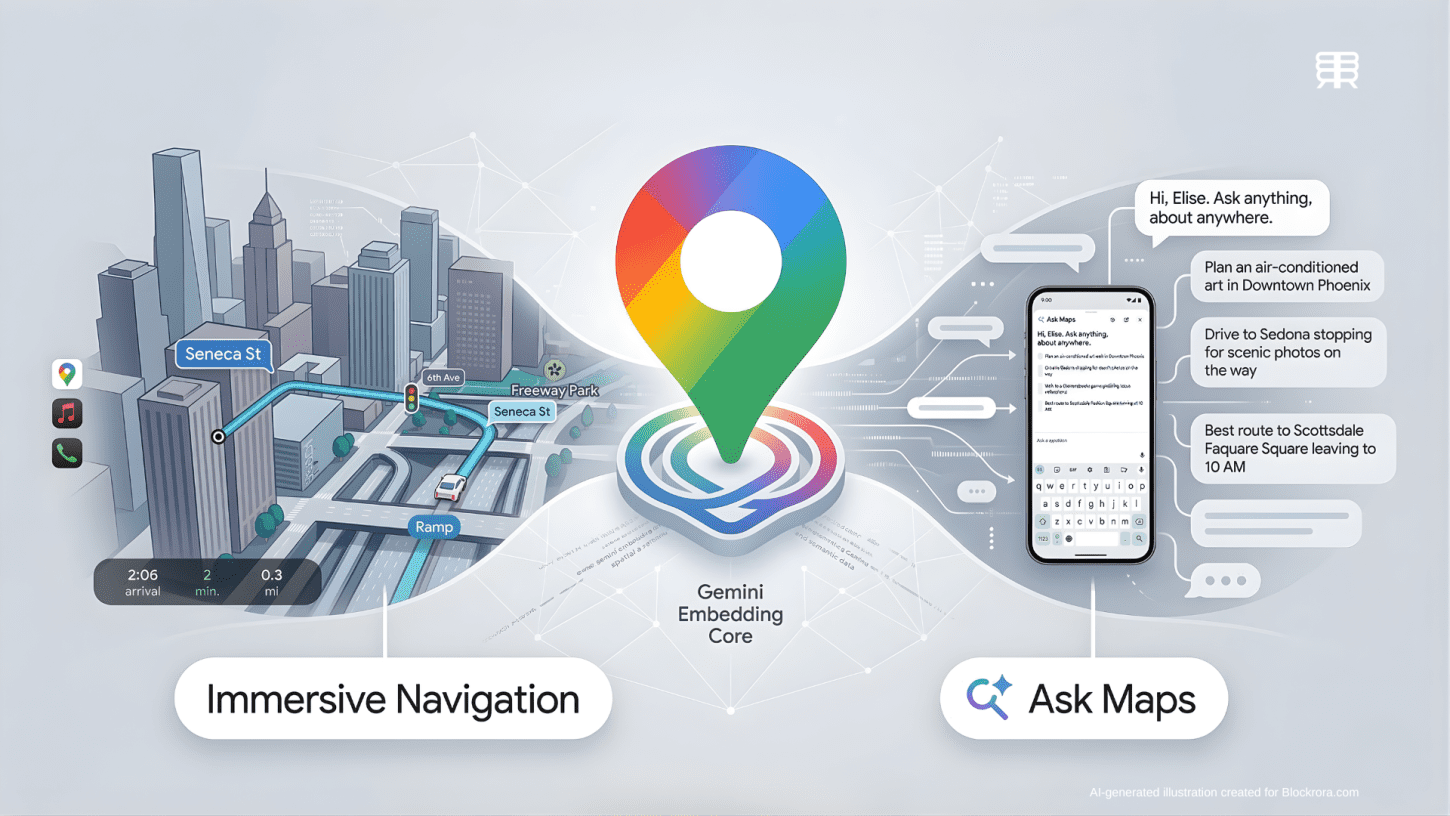
The headline feature, Ask Maps, introduces a conversational layer to the exploration experience. Instead of scrolling through hundreds of reviews, users can now ask nuanced questions like, “Where can I charge my phone without waiting in a long line for coffee?” or “Is there a public tennis court with lights on for a match tonight?”
This isn’t just a chatbot integrated into a map; it’s a reasoning engine. Maps now analyzes data from over 300 million places and insights from a community of 500 million contributors to provide personalized, conversational answers. Whether you’re seeking a “vegan-friendly spot with a cozy aesthetic” or a “hidden hiking trail near the Grand Canyon,” the system uses your search history and saved places to tailor its recommendations.
Immersive Navigation: The Death of the “Wrong Turn”
Navigation is also getting a massive visual and functional overhaul. Immersive Navigation brings the map to life with a vivid 3D view of buildings, terrain, and overpasses. This spatial intelligence allows Maps to highlight critical road details like specific lanes, crosswalks, and stop signs in real-time.
Key improvements include:
- Natural Voice Guidance: Instead of robotic prompts, you’ll hear instructions like, “Go past this exit and take the next one for Illinois 43 South,” mimicking how a human friend might navigate.
- Alternate Route Tradeoffs: Maps now explicitly shows the “why” behind route choices, comparing a longer trip with less traffic against a faster route with tolls.
- The Final Stretch: As you approach your destination, Maps highlights the building’s entrance and nearby parking, ensuring you don’t circle the block in confusion.
The Technical Core: Multimodal Intelligence
The ability for Maps to “understand” Street View imagery and aerial photos to generate these 3D environments is rooted in Google’s advancements in multimodal AI. For developers and tech enthusiasts, this rollout is a practical application of the concepts we explored in our Gemini Embedding 2: Multimodal Guide, which details how Google maps text, images, and video into a single, unified embedding space to capture complex semantic relationships.
A Broader Strategic Play
This update arrives at a pivotal moment in the AI race. As Google deepens the integration of Gemini into its own core products, it is simultaneously becoming the backbone for its competitors. We’ve recently covered the massive Apple-Google partnership to upgrade Siri, where Gemini will serve as the reasoning engine for Apple Intelligence.
However, as Google’s AI footprint expands across both Android and iOS, the long-term implications for market sovereignty remain a hot topic. As we noted in our strategic risk analysis of the Gemini alliance, while these partnerships provide immediate “frontier-level” capabilities, they also reinforce a pattern of strategic dependency that could lead to a complex corporate separation in the future.
Availability
Ask Maps and Immersive Navigation have begun rolling out in the U.S. and India on Android and iOS devices, with broader global expansion and desktop availability expected in the coming months. For a world increasingly dependent on digital layers to navigate physical reality, Google Maps is no longer just showing us where to go—it’s helping us understand what to do once we get there.
Frequently Asked Questions
What is Google “Ask Maps”?
Ask Maps is a new conversational experience within Google Maps powered by Gemini. It allows users to ask complex, open-ended questions—such as finding a quiet cafe with phone charging or a tennis court with evening lights—and receive personalized recommendations based on real-world data from over 300 million places.
How does Immersive Navigation work?
Immersive Navigation uses Gemini models to analyze Street View and aerial imagery, creating a vivid 3D representation of your route. It provides intuitive, “friend-like” voice guidance and highlights critical road details like lane changes, crosswalks, and building entrances to make driving more natural and less stressful.
Is the new Gemini-powered Google Maps available now?
Yes, Ask Maps and Immersive Navigation have begun rolling out in the U.S. and India for Android and iOS users. A broader global rollout and a desktop version are expected to follow throughout 2026.
How does this update relate to the Apple and Google AI partnership?
Google’s rapid deployment of Gemini in Maps serves as a live demonstration of the reasoning capabilities that will soon power the Siri upgrade. While Google uses Gemini to enhance its own ecosystem, it is also acting as the backend “brain” for Apple Intelligence, creating a unique dynamic of “cooperative competition.”
Does Google Maps use my personal data for these AI features?
Ask Maps provides personalized results based on your past searches and saved places. However, Google maintains that these features adhere to strict privacy standards, allowing users to manage their data and history within their Google Account settings.