The AI Powerhouse Built on Four Clients: Nvidia’s Fragile Core

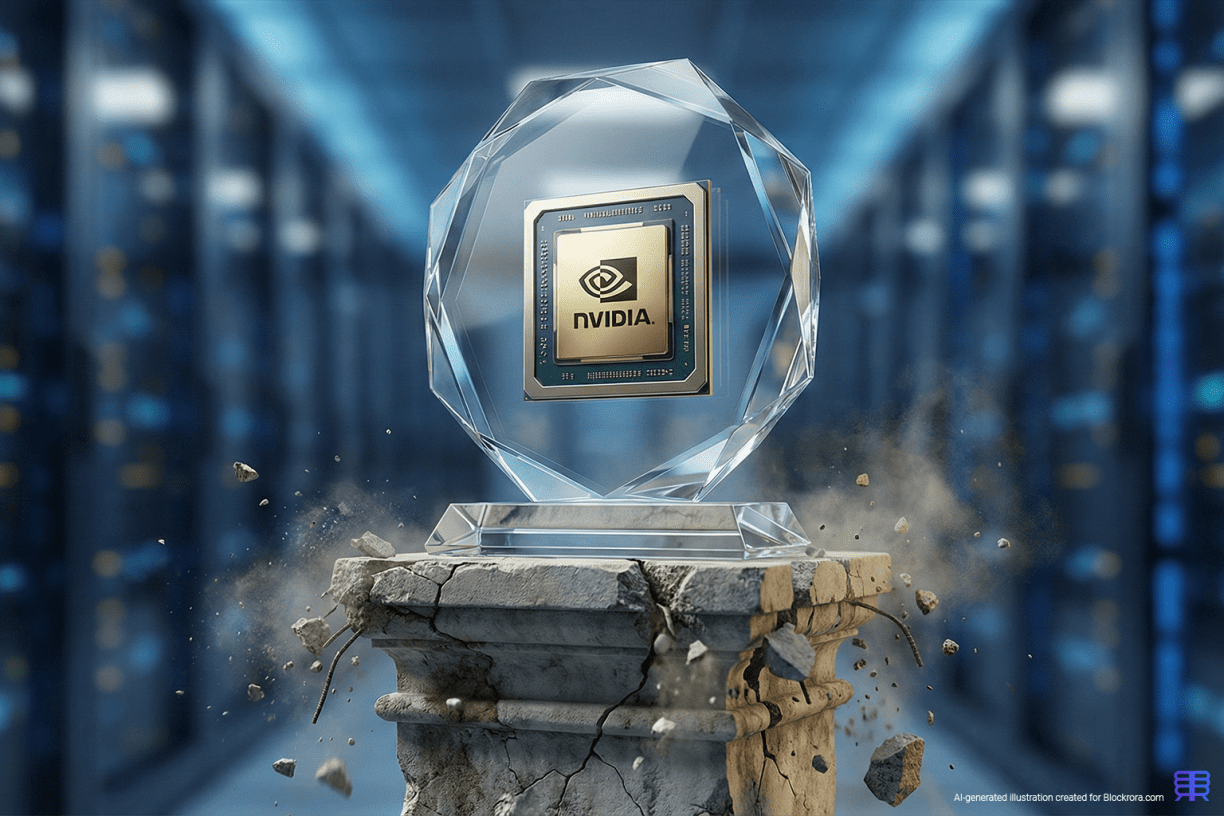
Nvidia’s record-breaking earnings cemented its dominance in the AI hardware market, but the company’s regulatory filings reveal a growing concentration risk that could test the durability of its trillion-dollar momentum. With over 60% of its revenue dependent on just four customers, analysts are questioning whether this growth represents a technological revolution or the early signs of an AI-driven financial bubble.
Nvidia’s Revenue Boom Masks Fragile Foundations
Nvidia’s ascent as the backbone of the AI economy has been fueled by demand for its high-performance GPUs, essential for powering large language models and data-intensive workloads. However, beneath the surge lies a worrying pattern: a narrow customer base and circular capital flows that blur the line between sustainable growth and speculative feedback loops.
According to Nvidia’s latest filings, four unnamed clients accounted for 61% of its $57 billion in quarterly revenue, up from 56% the previous quarter. Analysts suggest that these may include major cloud providers such as Microsoft, Meta, and Oracle, companies that are both reliant on Nvidia’s chips and increasingly intertwined with its financial ecosystem.
Huang’s “Tipping Point” Narrative Meets Investor Skepticism
CEO Jensen Huang continues to frame Nvidia’s trajectory as a transformative moment for the global economy. In his recent earnings call, he argued that the industry is not in a bubble, but rather at a “tipping point” where AI will reshape every sector.
However, skeptics are less convinced. They point to extreme customer dependency and rising cross-investments between Nvidia and its clients as signs of structural fragility. Some analysts warn that the company’s growth is being driven by “loss-making startups or projects,” suggesting the cycle could end abruptly if funding dries up.
The Three Transitions Defining Nvidia’s Strategy
Huang outlined a three-phase roadmap for Nvidia’s future growth:
- Software Migration to GPUs: Moving non-AI workloads, like simulations and data analytics, from CPUs to Nvidia GPUs.
- AI-Native Software Creation: Developing new categories such as autonomous coding assistants and AI-driven design tools.
- AI in the Physical World: Expanding into robotics, vehicles, and industrial automation.
While these transitions position Nvidia as a central player in AI’s evolution, they also hinge on continued, capital-intensive demand from a small group of hyperscalers, the same group that forms its financial backbone.
The Circular Flow of AI Capital
A more complex issue lies in the feedback loop of capital moving between Nvidia and its customers. Regulatory disclosures show Nvidia renting back its own chips from cloud providers in contracts worth over $26 billion, double the previous year’s figure, and investing billions into AI firms like OpenAI and Anthropic, both of which are major customers.
This creates what analysts describe as a “circular economy of AI capital” where Nvidia’s revenue is partly fueled by the very funds it injects into its client ecosystem. The structure raises concerns about transparency, sustainability, and whether the demand is organic or artificially supported by financial engineering.
Competitive and Infrastructure Headwinds Ahead
Even if Nvidia sustains its current trajectory, emerging trends pose serious challenges. Cloud giants like Google and Amazon are actively developing in-house chips to cut costs and reduce dependence on Nvidia. This internal competition could eventually erode Nvidia’s pricing power and market share.
Meanwhile, the infrastructure demands of the AI revolution, particularly the need for vast amounts of power and land to build data centers, may become limiting factors. Huang acknowledged these constraints, describing them as “tractable” and “solvable,” but energy and supply chain bottlenecks remain a growing concern.
The Bigger Picture – AI’s Economic Architecture
Nvidia’s success has become synonymous with the AI boom, but its reliance on a handful of hyperscalers highlights an uncomfortable truth about the current phase of artificial intelligence: much of the industry’s value creation is concentrated among a small cluster of corporations, creating systemic risk.
As regulators and investors scrutinize this dependency, the company’s next challenge will be proving that its growth is built on innovation, not on a self-reinforcing cycle of capital and compute.