Rivian Rebuilds Its Self-Driving Strategy Around AI and Fleet Data

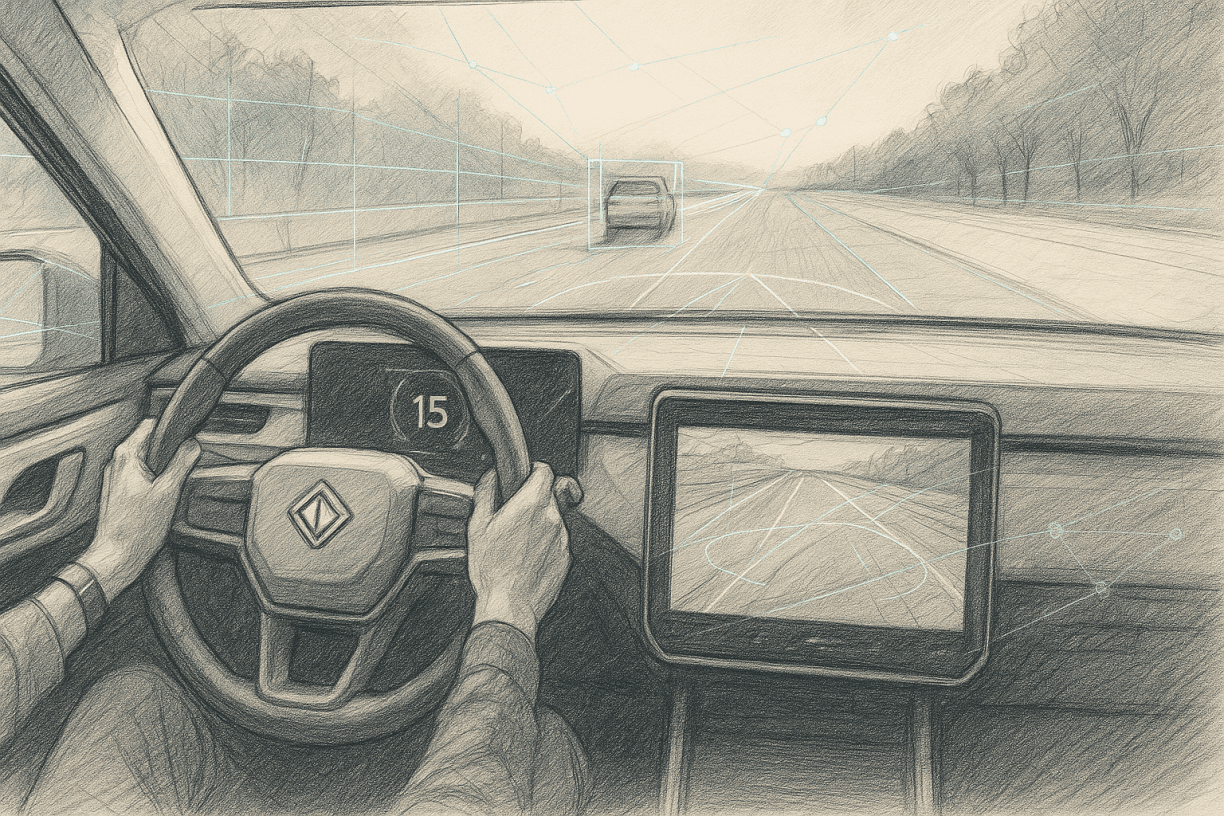
Rivian has outlined a major shift in how it plans to deliver automated driving, rebuilding its self-driving platform around artificial intelligence trained on real-world vehicle data. The strategy marks a move away from traditional rules-based driver assistance systems and places Rivian on a similar technical path to other AI-first autonomy efforts in the automotive sector.
The details were shared during Rivian’s Autonomy & AI Day at its Palo Alto headquarters, where executives demonstrated early versions of what the company calls its Large Driving Model and clarified how and when new autonomy features will reach customers, according to reporting from TechCrunch.
A Quiet Pivot That Began in 2021
Rivian CEO RJ Scaringe said the company began rethinking its autonomy strategy in 2021 after advances in transformer-based AI models showed promise beyond deterministic control systems. Rivian’s earlier driver assistance software relied on predefined rules written by engineers, dictating how vehicles should respond to specific scenarios.
That approach was ultimately scrapped. Scaringe confirmed the autonomy team was restructured and tasked with building a system designed for an AI-centric driving stack, trained to interpret and respond to real-world conditions rather than follow static instructions.
The new software platform was introduced in 2024 on second-generation R1 vehicles, which run on Nvidia Orin processors.
Testing the Large Driving Model in Real Conditions
During a supervised demonstration drive in a 2025 Rivian R1S, the Large Driving Model handled basic driving tasks such as traffic lights, turns, and speed bumps without relying on hard-coded rules. The system operates end-to-end, interpreting sensor data and generating driving actions directly.
However, the test also revealed current limitations. The vehicle disengaged once during a narrow, partially obstructed road segment, and similar disengagements were observed in other demonstration vehicles. Rivian emphasized that the software shown during the event is still under development and not yet ready for consumer release.
TechCrunch, which attended the event and participated in the demo ride, reported that the overall performance reflected steady progress but underscored how challenging generalized self-driving remains.
Hands-Free Driving Arrives This Month
Rivian plans to roll out a feature called “Universal Hands-Free” later this month. The update will allow drivers to remove their hands from the steering wheel on approximately 3.5 million miles of roads across the United States and Canada, provided lane markings are visible.
The system will still require drivers to keep their eyes on the road and remain prepared to take control. Point-to-point automated driving, which allows the vehicle to navigate between destinations without continuous driver input, is scheduled for the second half of 2026.
The R2 Timeline and a Hardware Transition
Rivian’s long-term autonomy goals are closely linked to the launch of its upcoming R2 SUV line. By the end of 2026, the company plans to move away from Nvidia hardware and introduce a custom-built autonomy computer paired with lidar sensors.
This hardware upgrade is expected to support both hands-off and eyes-off driving, a step toward higher levels of automation. However, the timing creates a gap for early R2 buyers. Vehicles sold during the initial launch period will support hands-free point-to-point driving but will not include eyes-off capability.
Scaringe acknowledged the challenge, noting that vehicle production timelines and autonomy platform development do not always align. Rivian’s approach, he said, is to be transparent so customers can decide whether to purchase early or wait for more advanced hardware.
Data, Not Demos, Will Decide the Outcome
Rivian’s strategy depends on how quickly it can scale data collection across its vehicle fleet and refine its Large Driving Model using real-world driving scenarios. The company believes that accelerating data intake will allow the system to improve more rapidly than traditional rule-based approaches.
While Rivian has outlined a clear technical direction, true driverless operation — where no supervision is required — remains a longer-term goal. The pace at which Rivian’s AI model matures will determine how quickly the company can move beyond supervised automation and closer to full autonomy.