• Get in touch
  • Partner with us
  • Explore Shop
  • About Blockrora
  • Login
  • Register
Upgrade
Blockrora
  • Technology
  • Blockchain
  • Business
  • Finance
  • Science
  • Health
  • Education
No Result
View All Result
  • Technology
  • Blockchain
  • Business
  • Finance
  • Science
  • Health
  • Education
No Result
View All Result
Blockrora
No Result
View All Result
Home Blockchain News & Analysis

Safety Valve or Permanent Fix? Inside Bitcoin’s First Quantum-Resistant Transaction

Blockrora by Blockrora
September 16, 2026
Reading Time: 4 mins read
18
A A
0
An inside look at Bitcoin’s first quantum-resistant transaction. Is post-quantum cryptography a temporary safety valve or the permanent security fix needed?

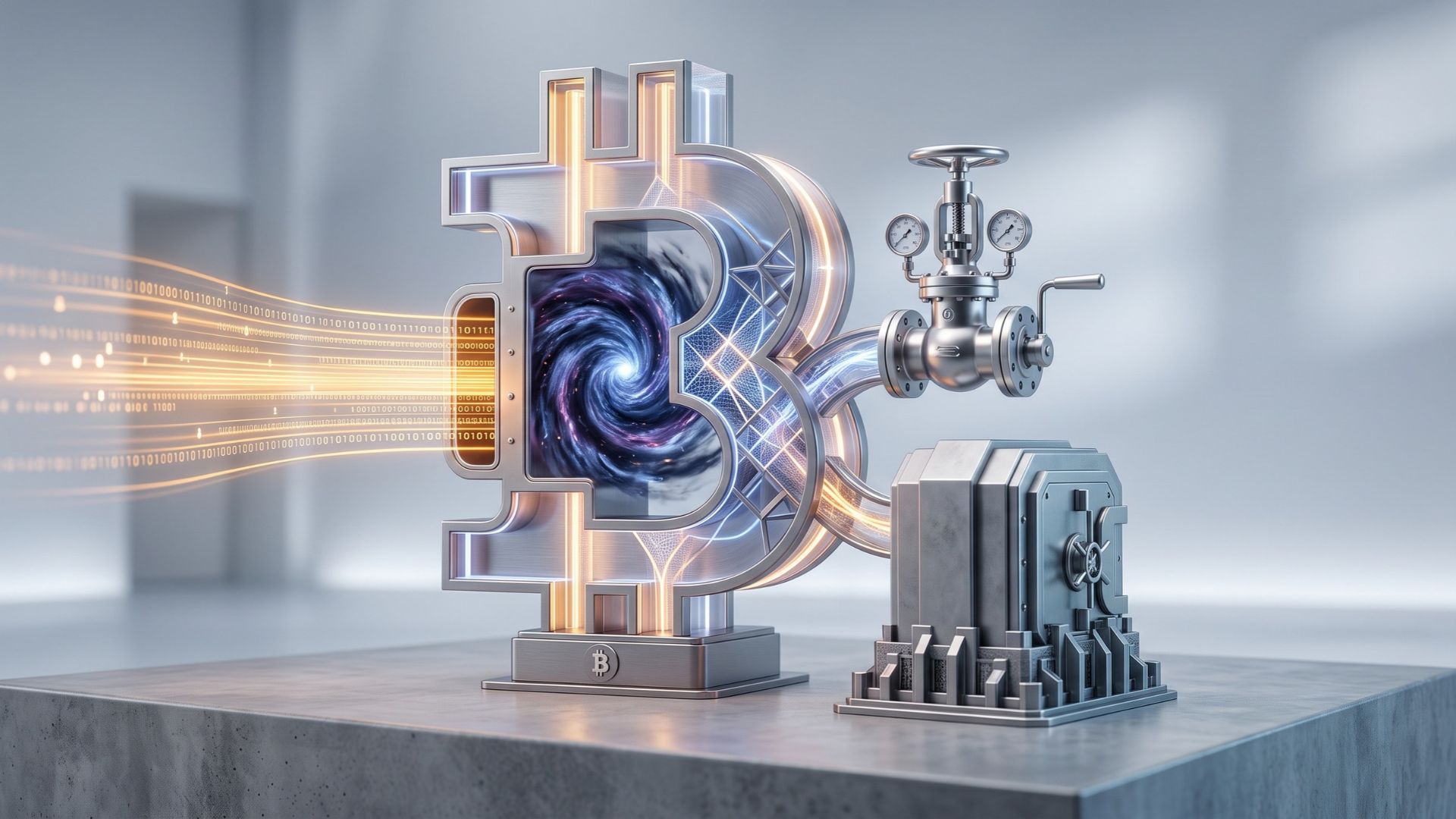
Minimalist 3D render of a metallic Bitcoin emblem integrated with a mechanical pressure valve and heavy security vault against a clean studio background.

The long-standing hypothetical threat of quantum computing breaking modern cryptography just met its first real-world defense on the Bitcoin blockchain. StarkWare recently confirmed that the first-ever quantum-safe transaction had been successfully mined on the Bitcoin mainnet. Rather than relying on theoretical academic whitepapers or waiting years for network-wide consensus, developers demonstrated that a Bitcoin holder can shield assets against future quantum attacks today.

The milestone challenges a persistent belief within the cryptocurrency industry: that protecting Bitcoin from quantum adversaries would inevitably demand a contentious hard fork or a fundamental overhaul of the network’s underlying consensus rules. Yet while the demonstration marks an undeniable technical breakthrough, its mechanics show that the path to universal quantum security remains complex, expensive, and far from solved.

You might also like

$320M Drained: Bitcoin Sidechain Liquid Network Pauses Operations After Massive Exploit

Smart Contracts Under Siege? What OpenAI’s Astra Means for Web3 and Protocol Security

SafePal Discloses Order Data Breach: Nearly 40,000 Hardware Wallet Customers Exposed

The Looming Shadow of Shor’s Algorithm

Bitcoin’s security model fundamentally depends on elliptic curve cryptography, specifically the ECDSA and Schnorr signature schemes. These mathematical functions make it trivial to generate a public key from a private key, while making the reverse calculation computationally impossible for classical supercomputers.

A sufficiently advanced quantum computer changes that equation entirely. Running Shor’s algorithm, such a machine could theoretically solve discrete logarithms in polynomial time, deriving private keys directly from exposed public keys. For years, cryptographers have warned of “Q-Day”, the moment quantum hardware reaches the scale necessary to unravel legacy encryption and drain vulnerable wallets.

StarkWare’s method, termed Quantum-Safe Bitcoin (QSB), bypasses this vulnerability by altering the cryptographic lock protecting individual coins. Instead of anchoring transaction authorization to an elliptic curve signature, QSB pairs the asset with a secondary layer governed by hash functions. Because hash functions do not rely on the algebraic structure vulnerable to Shor’s algorithm, they remain intrinsically resistant to quantum decryption.

How Signature Grinding Outsmarts the System

The most elegant aspect of the breakthrough is that it functions within Bitcoin exactly as the software exists today. The method relies on an off-chain computational technique known as signature grinding.

Instead of signing a transaction with a conventional private key that might later be compromised, the sender expends heavy computational energy searching for a transaction whose hash matches the exact formatting requirements of a valid Bitcoin signature. The Bitcoin network validates the resulting transaction without ever needing an underlying elliptic curve private key to exist in the first place.

By shifting the proof of ownership from the secrecy of a private key to the one-way difficulty of reversing a hash, the funds become immune to the mathematical shortcuts quantum computers exploit. The entire workload occurs off-chain, presenting the blockchain with standard cryptographic outputs that comply with existing transaction rules.

High Costs and Mempool Bypasses

Despite its cryptographic ingenuity, QSB is not retail-ready. For the average investor holding satoshis in a hardware wallet, the process is practically inaccessible.

Generating a single quantum-resistant transaction under this scheme requires several hours of dedicated computational time, translating to roughly $150 to $200 in raw compute costs per transaction. Furthermore, because these transactions leverage non-standard scripts, they cannot propagate through Bitcoin’s public mempool alongside regular peer-to-peer transfers. Instead, users must submit their transactions directly to cooperating mining pools to be packaged into a block, introducing logistical friction and custodial touchpoints.

These operational hurdles underscore why experts describe the mechanism as an emergency safety valve rather than an immediate, everyday payment standard. It provides high-value custodians and sovereign holders with an escape hatch, but it does not represent an agile transaction network.

The Collective Defense Dilemma

The deeper issue facing Bitcoin is that individual security tools cannot resolve systemic network vulnerabilities. Cryptographers estimate that approximately 30 percent of all circulating Bitcoin sits in addresses where the public key has already been revealed on-chain, including Satoshi Nakamoto’s early coinbase rewards and legacy Pay-to-Public-Key outputs.

If a powerful quantum computer emerges, any coins with exposed public keys could be stolen and dumped onto exchanges, crashing market liquidity regardless of how well private entities have fortified their individual reserves. Furthermore, abandoned coins whose owners have lost their access cannot proactively migrate to hash-based protections, leaving a vast reservoir of value permanently vulnerable to extraction by bad actors.

StarkWare’s successful mainnet transaction dispels the fatalistic notion that the Bitcoin community must sit idle until consensus is achieved. It proves that clever engineering can construct post-quantum shelters within legacy constraints. However, safeguarding the broader digital asset economy will ultimately require collective governance, seamless wallet integration, and eventually, protocol-level upgrades that protect all holders, not just those with the compute power to grind their own keys.

Buy Blockrora a Coffee

Donate a coffee to support the Blockrora writing desk. Your contribution funds deep-dive research and uninhibited tech news.

Donate $5
Tags: BitcoinCryptoCryptographyquantum computing
SendShare15Tweet10Share3SummarizeSummarize
Previous Post

Anthropic CEO Dario Amodei Urges AI Industry to Slow Model Development Amid Misalignment and Misuse Risks

Next Post

Can AI Police Itself? Inside Microsoft’s Constitution for Autonomous Agents

Blockrora

Blockrora

Blockrora is an independent global news platform decoding the intersection of emerging technology, business, and science. No fluff, no jargon, just sharp, tech-forward journalism.

Related Posts

Minimalist 3D render of a cracked reservoir draining liquid beside an emergency pause button, representing the Bitcoin Liquid Network exploit.
Blockchain News & Analysis

$320M Drained: Bitcoin Sidechain Liquid Network Pauses Operations After Massive Exploit

by Blockrora
September 8, 2026
244
Minimalist translucent blockchain cubes illuminated by OpenAI logo projections, representing Web3 smart contract security risks.
Blockchain News & Analysis

Smart Contracts Under Siege? What OpenAI’s Astra Means for Web3 and Protocol Security

by Blockrora
September 8, 2026
239
SafePal hardware wallet resting on a concrete plinth beside a glowing fragmented shipping label and dispersing data particles
Blockchain News & Analysis

SafePal Discloses Order Data Breach: Nearly 40,000 Hardware Wallet Customers Exposed

by Blockrora
August 17, 2026
247
A minimalist 3D editorial graphic showing a sleek glass and metal cube being fractured by a heavy, metallic chain-link sphere, symbolising the impact of blockchain-enforced data rights over centralised platforms.
Blockchain News & Analysis

Meta Misses the Mark: The Blockchain Case for Protocol-Enforced Data Rights

by Blockrora
July 14, 2026
246
Next Post
A conceptual 3D render of a futuristic, structured glass and metal cube containing a glowing blue energy ring, symbolizing Microsoft's AI constitution for governing autonomous agents.

Can AI Police Itself? Inside Microsoft’s Constitution for Autonomous Agents

Leave a Reply Cancel reply

Your email address will not be published. Required fields are marked *

ADVERTISEMENT

Premium Content

A minimalistic 3D editorial photograph of a blue Amazon Prime delivery box with embossed South African cultural symbols, featuring Table Mountain and a King Protea flower in the background.

The Slow Burn: Why Amazon Waited Two Years to Drop the Prime Carrot in Mzansi

June 3, 2026
250
Surgeon holding a high-resolution brain implant device with microelectrodes during neural interface testing.

Neuralink Has Competition: Paradromics Completes First Human Brain Implant Procedure

June 7, 2025
240
Flare Network: Redefining Decentralized Oracles with FTSOv2

Flare Network’s FTSOv2: A Breakthrough for Decentralized Data Delivery

April 16, 2024
241

Browse by Category

  • Blockchain News & Analysis
  • Breaking News & Updates
  • Business News & Insights
  • Education Sector News
  • Finance & Markets News
  • Health & Science Reporting
  • Marketing & Media Trends
  • Opinions & Editorials
  • Press Releases & Announcements
  • Science & Innovation News
  • Technology News & Reviews
  • Travel & Tourism

Browse by Tags

AI AI advancements AI agents AI Infrastructure AI regulation AI Safety Amazon Anthropic Apple Apple Intelligence Artificial intelligence Bitcoin Blockchain Blockchain security ByteDance ChatGPT Claude AI Cloud Computing creator economy Crypto Crypto adoption Cryptocurrency Crypto payments Crypto Regulation Cybersecurity Data privacy Decentralized Finance DeFi Elon Musk Fintech Google Google AI Meta Meta AI Microsoft NVIDIA OpenAI Social Media South Africa SpaceX Stablecoins Starlink tech news TikTok Web3
Blockrora light logo

Blockrora is an independent global news platform decoding the intersection of emerging technology, business, and science. No fluff, no jargon, just sharp, tech-forward journalism.

Categories

  • Blockchain News & Analysis
  • Breaking News & Updates
  • Business News & Insights
  • Education Sector News
  • Finance & Markets News
  • Health & Science Reporting
  • Marketing & Media Trends
  • Opinions & Editorials
  • Press Releases & Announcements
  • Science & Innovation News
  • Technology News & Reviews
  • Travel & Tourism

About us

  • Partnerships
  • Privacy Policy
  • Terms of Service
  • Acceptable Use Policy
  • Diversity & Inclusion
  • Editorial Standards & Ethics
  • Refund & Return Policy
  • Sitemap
  • RSS Feed

Recent Posts

  • Can AI Police Itself? Inside Microsoft’s Constitution for Autonomous Agents
  • Safety Valve or Permanent Fix? Inside Bitcoin’s First Quantum-Resistant Transaction
  • Anthropic CEO Dario Amodei Urges AI Industry to Slow Model Development Amid Misalignment and Misuse Risks

© 2026 Blockrora - Blockchain, Business, Tech & Global News.

Welcome Back!

Sign In with Facebook
Sign In with Google
Sign In with Linked In
OR

Login to your account below

Forgotten Password? Sign Up

Create New Account!

Sign Up with Facebook
Sign Up with Google
Sign Up with Linked In
OR

Fill the forms bellow to register

All fields are required. Log In

Retrieve your password

Please enter your username or email address to reset your password.

Log In
  • Login
  • Sign Up
  • Cart
No Result
View All Result
  • Technology
  • Blockchain
  • Business
  • Finance
  • Science
  • Health
  • Education

© 2026 Blockrora - Blockchain, Business, Tech & Global News.

Secret Link
Not enough quota to unlock this post
Unlock left : 0
Are you sure want to cancel subscription?
Go to mobile version