• Get in touch
  • Partner with us
  • Explore Shop
  • About Blockrora
  • Login
  • Register
Upgrade
Blockrora
  • Technology
  • Blockchain
  • Business
  • Finance
  • Science
  • Health
  • Education
No Result
View All Result
  • Technology
  • Blockchain
  • Business
  • Finance
  • Science
  • Health
  • Education
No Result
View All Result
Blockrora
No Result
View All Result
Home Science & Innovation News

From Silicon to Cells: Inside the Rise of the World’s First Living Computer

Blockrora by Blockrora
October 31, 2025
in Science & Innovation News, Technology News & Reviews
17
A A
0
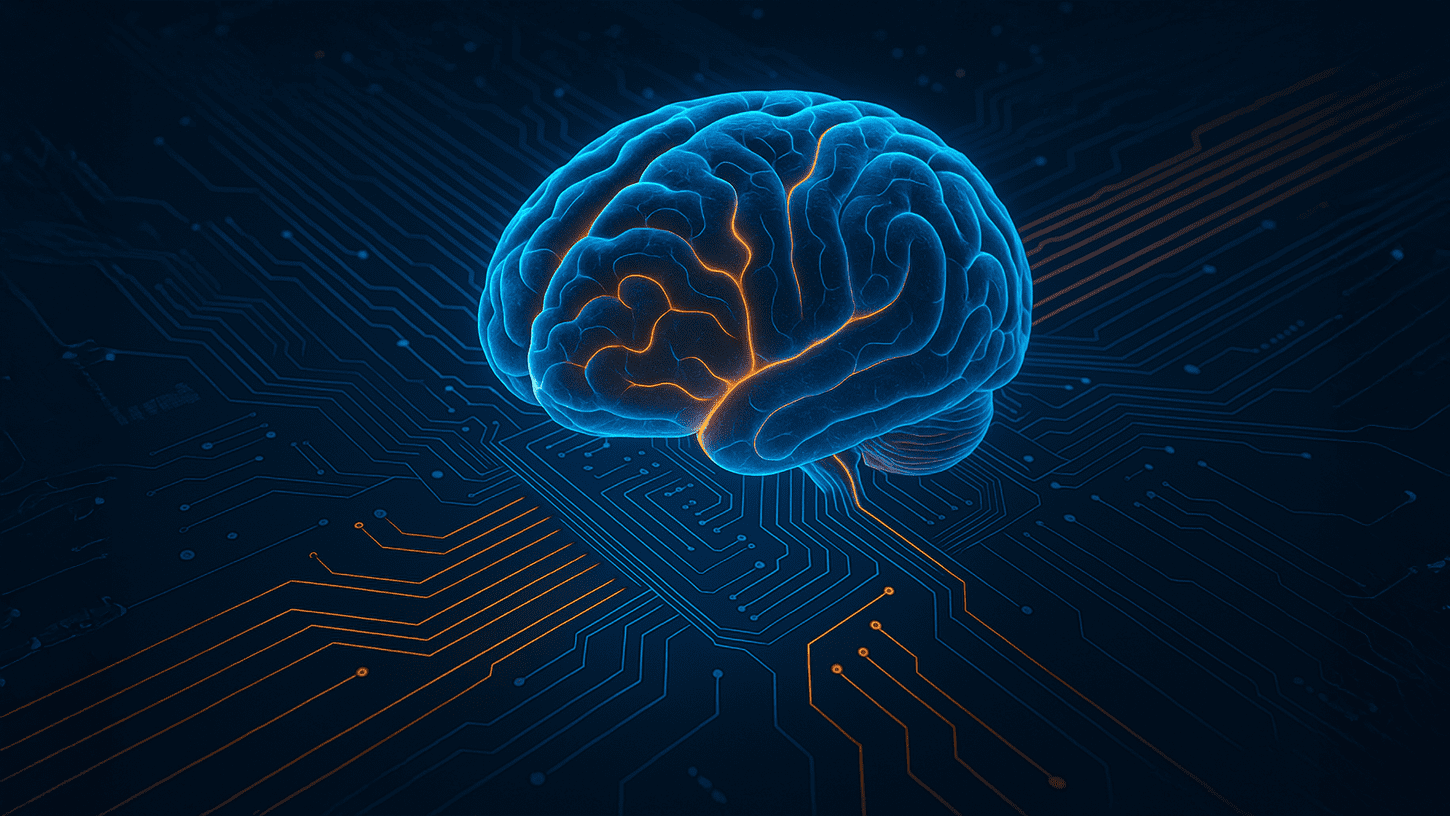
A detailed 3D visualization of a glowing human brain merging with electronic circuits, symbolizing the rise of wetware biocomputing and living computers.

A 3D-rendered concept of wetware computing, where human neurons and circuitry converge to form the world’s first living computer.

The race to make Artificial Intelligence faster and more efficient has pushed computing to its physical limits. As AI models become increasingly complex, the global demand for computing power and the electricity that powers it, has become almost insatiable.
What if the next leap in computing didn’t come from silicon chips, transistors, or quantum processors, but from living human brain cells?

A pioneering Swiss startup named FinalSpark believes it has found the key to that future. Its creation, dubbed the world’s first “living computer”, uses clusters of real human neurons to process information, marking the birth of what scientists are calling wetware or biocomputing.

You might also like

AI Voice-Cloning Met Its Match: Google Deploys Real-Time Deepfake Detection on Android

TikTok’s Fintech Frontier: The Rise of a Global Super App

The End of the Engagement Farm: Inside X’s Crackdown on Content Piracy

The Birth of Wetware

For decades, engineers have tried to replicate the human brain’s efficiency in machines. Artificial neural networks, the foundation of modern AI, are inspired by biology but remain significantly less efficient compared to their natural counterparts.

Dr. Fred Jordan, co-founder of FinalSpark, decided to flip that logic:

“Instead of mimicking the brain with silicon,” he said, “why not use the real thing?”

FinalSpark’s approach is as radical as it is elegant. The company grows mini-brains, or organoids, made from human skin cells that are reprogrammed into stem cells and developed into neurons. Each organoid, about the size of a fruit fly’s brain, contains roughly 10,000 living neurons, capable of transmitting electrical signals, learning from stimuli, and even forming primitive networks.

These organoids are suspended in a nutrient solution and connected to electrodes. When scientists send electrical pulses through them, the neurons react with activity spikes, the biological equivalent of ones and zeros in traditional computing.

A Million-Fold Efficiency Advantage

The driving force behind this innovation is efficiency.
According to Dr. Jordan, biological neurons are one million times more energy-efficient than artificial ones. A single neuron consumes just a fraction of the energy needed by a transistor to perform a comparable operation.

This staggering efficiency could eventually transform the environmental footprint of AI. Data centers, the backbone of our digital world, currently consume nearly 2% of global electricity and trillions of liters of water annually. Wetware computing, by contrast, promises computation that is self-organizing, self-healing, and drastically less power-intensive.

In theory, a data center powered by living neurons could accomplish what today’s supercomputers do, using a fraction of the energy.

Learning Through Dopamine

What makes biocomputers truly fascinating isn’t just that they can compute; it’s that they can learn.
In experiments, researchers have “trained” these neural clusters by sending repetitive signals and rewarding correct responses with tiny doses of dopamine, the brain’s natural “pleasure” chemical.

The result? Mini-brains that begin to adapt and improve performance over time, mimicking the reinforcement learning that powers human behavior. It’s the closest thing yet to teaching living tissue to think computationally.

Collaboration and Early Adoption

FinalSpark has opened its technology to researchers worldwide.
So far, 10 universities across multiple countries have joined the effort to explore the potential of living processors.

Elsewhere, Australian startup Cortical Labs made headlines after training brain cells to play the classic video game Pong. Meanwhile, scientists at Johns Hopkins University are using similar organoid systems to model neurological disorders like Alzheimer’s and autism, potentially replacing animal testing with more accurate human-based models.

Ethical Boundaries and Technical Challenges

While the possibilities sound straight out of science fiction, the technology faces serious hurdles, both biological and ethical.

For one, organoids have no blood vessels, meaning they can only survive for a few months before their neurons begin to degrade. They must also be kept alive in highly controlled environments, fed constantly with nutrient solutions, and cannot simply be rebooted like digital machines.

On the ethical front, FinalSpark insists its organoids do not possess consciousness. They lack the structural complexity, sensory systems, and pain receptors required for subjective experience. Still, the company works closely with bioethicists to ensure that as the technology evolves, so do the frameworks that govern its use.

Dr. Lena Smirnova from Johns Hopkins University believes wetware computing will complement, not replace, silicon in the near future:

“It’s not about building a thinking machine — it’s about expanding what we can do with living systems.”

A Glimpse Into the Future

The long-term vision for wetware computing is breathtaking. Imagine data centers powered by living neurons, capable of learning and adapting in real time without draining vast electrical grids.

In such a world, artificial intelligence could evolve within biological substrates, blending the efficiency of nature with the precision of engineering. While this future is still years away, FinalSpark’s prototype has opened the door to a new paradigm, one where computation isn’t just mechanical, but alive.

As the age of silicon slowly meets its biological successor, one thing is clear:
the next revolution in computing may not be coded, it may be cultured.

Tags: AI innovationbiocomputingFinalSparkhuman neuronsliving computerwetware computing
SendShare15Tweet9Share3
Previous Post

Mastercard Eyes $2B Zero Hash Deal to Lead the Stablecoin Payments Race

Next Post

Eyes in the Sky: How AI and Satellites Are Counting Africa’s Great Migration

Blockrora

Blockrora

Blockrora is an independent global news platform decoding the intersection of emerging technology, business, and science. No fluff, no jargon, just sharp, tech-forward journalism.

Related Posts

A 3D-style editorial illustration of an Android smartphone on a minimalist background. Holographic layers rise from the screen, showing an analytical wireframe, a facial recognition heatmap overlaying a person's face, and a digital security shield, symbolising Google's real-time deepfake detection technology.
Technology News & Reviews

AI Voice-Cloning Met Its Match: Google Deploys Real-Time Deepfake Detection on Android

by Blockrora
June 3, 2026
231
A minimal, 3D editorial graphic showing the TikTok logo at the centre, connected by glowing neon lines to icons for shopping, banking, video messaging, and global networking against a clean, light grey background.
Technology News & Reviews

TikTok’s Fintech Frontier: The Rise of a Global Super App

by Blockrora
June 2, 2026
236
A minimalistic 3D editorial graphic showing a high-tech security interface blocking pirated media content, featuring a prominent X logo and a security operator.
Technology News & Reviews

The End of the Engagement Farm: Inside X’s Crackdown on Content Piracy

by Blockrora
June 2, 2026
238
A minimalistic, photograph-like view of a sub-Saharan Kenyan savannah at dusk, with a small herd of elephants and a bold, red Huawei logo projected like a Batman signal into the starry night sky.
Technology News & Reviews

Silicon Savannah Goes East: Kenya’s Digital Champions Head to Shenzhen for Global ICT Finals

by Blockrora
June 1, 2026
240
Next Post
A 3D realistic view of a satellite tracking wildebeest herds across the Serengeti-Mara plains using AI technology, blending innovation with nature.

Eyes in the Sky: How AI and Satellites Are Counting Africa’s Great Migration

Leave a Reply Cancel reply

Your email address will not be published. Required fields are marked *

ADVERTISEMENT

Premium Content

Illustration representing the Coursera and Udemy $2.5 billion merger in online education and AI-driven learning platforms

Coursera and Udemy Agree to $2.5B Merger as Edtech Pivots to AI

December 18, 2025
232
photo, man standing in a suburbia street where every house and car is made from Bitcoin or blockchain elements

Real-World Assets (RWAs) on the Blockchain: A New Frontier for Investors

May 21, 2024
231
Ledger unveils the Recovery Key, a secure NFC card to store your crypto recovery phrase offline using certified hardware security. Learn how it works.

Ledger Unveils the Recovery Key: A Physical NFC Backup for Next-Gen Self-Custody

June 25, 2025
232

Browse by Category

  • Blockchain News & Analysis
  • Breaking News & Updates
  • Business News & Insights
  • Education Sector News
  • Finance & Markets News
  • Health & Science Reporting
  • Marketing & Media Trends
  • Opinions & Editorials
  • Press Releases & Announcements
  • Science & Innovation News
  • Technology News & Reviews
  • Travel & Tourism

Browse by Tags

AI AI agents AI Infrastructure AI regulation AI Safety Amazon Anthropic Apple Apple Intelligence Artificial intelligence Automation Bitcoin Blockchain Blockchain infrastructure Blockchain security ChatGPT Cloud Computing Crypto adoption Cryptocurrency Crypto payments Crypto Regulation Cybersecurity Data privacy Decentralized Finance DeFi Fintech Generative AI Google AI Google Gemini Klever KleverChain KunaiKash Meta Meta AI Microsoft NVIDIA OpenAI Smart contracts Social Media SpaceX Stablecoins Starlink tech news TikTok Web3
Blockrora light logo

Blockrora is an independent global news platform decoding the intersection of emerging technology, business, and science. No fluff, no jargon, just sharp, tech-forward journalism.

Categories

  • Blockchain News & Analysis
  • Breaking News & Updates
  • Business News & Insights
  • Education Sector News
  • Finance & Markets News
  • Health & Science Reporting
  • Marketing & Media Trends
  • Opinions & Editorials
  • Press Releases & Announcements
  • Science & Innovation News
  • Technology News & Reviews
  • Travel & Tourism

About us

  • Partnerships
  • Privacy Policy
  • Terms of Service
  • Acceptable Use Policy
  • Diversity & Inclusion
  • Editorial Standards & Ethics
  • Refund & Return Policy
  • Sitemap
  • RSS Feed

Recent Posts

  • AI Voice-Cloning Met Its Match: Google Deploys Real-Time Deepfake Detection on Android
  • The Slow Burn: Why Amazon Waited Two Years to Drop the Prime Carrot in Mzansi
  • TapTools Winds Down Operations Amid Cardano’s Structural Headwinds

© 2026 Blockrora - Blockchain, Business, Tech & Global News.

Welcome Back!

Sign In with Facebook
Sign In with Google
Sign In with Linked In
OR

Login to your account below

Forgotten Password? Sign Up

Create New Account!

Sign Up with Facebook
Sign Up with Google
Sign Up with Linked In
OR

Fill the forms bellow to register

All fields are required. Log In

Retrieve your password

Please enter your username or email address to reset your password.

Log In
  • Login
  • Sign Up
  • Cart
No Result
View All Result
  • Technology
  • Blockchain
  • Business
  • Finance
  • Science
  • Health
  • Education

© 2026 Blockrora - Blockchain, Business, Tech & Global News.

Secret Link
Not enough quota to unlock this post
Unlock left : 0
Are you sure want to cancel subscription?
Go to mobile version