

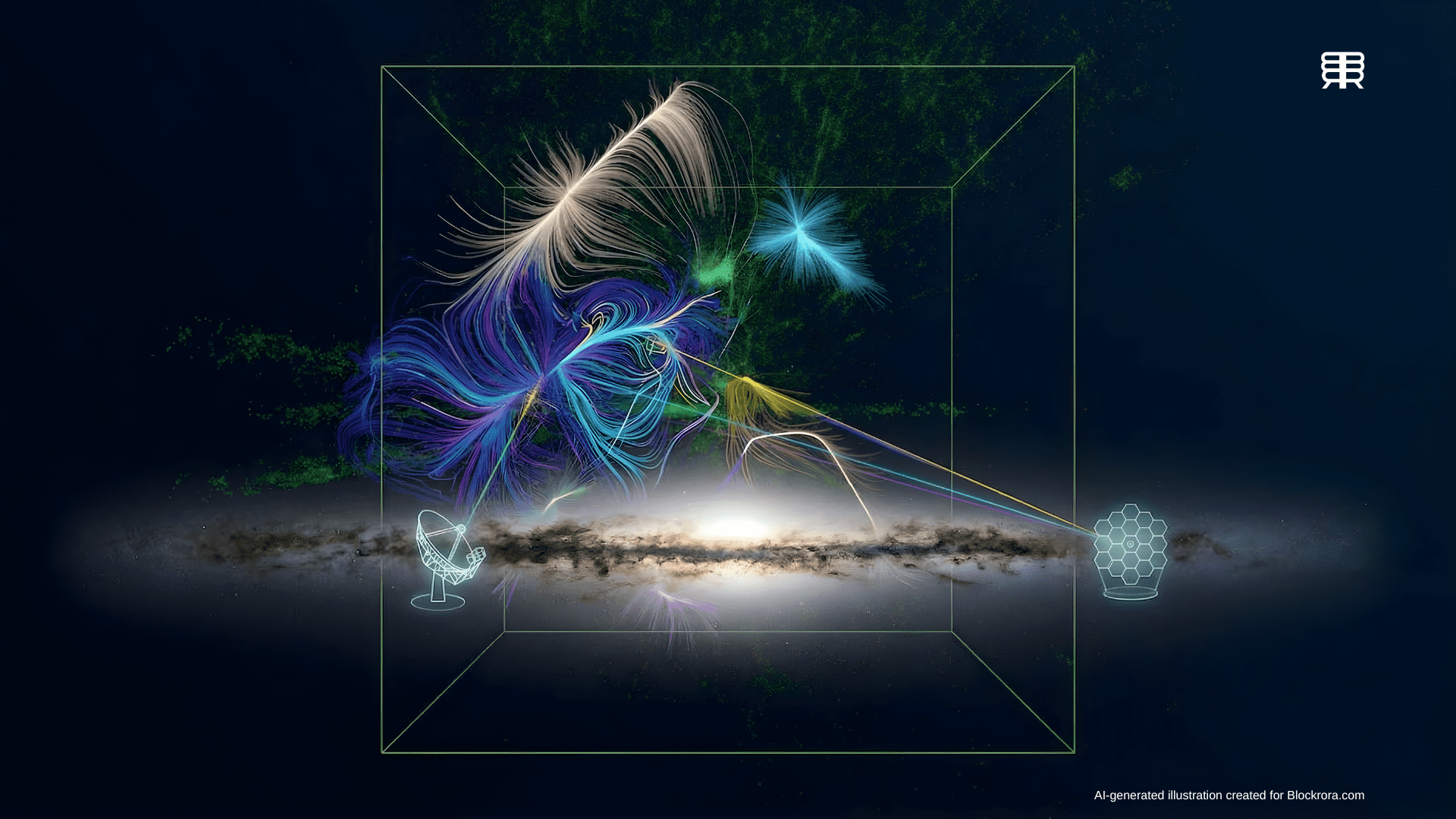
Researchers at the University of Cape Town (UCT) have uncovered a massive galactic supercluster previously obscured by the Milky Way’s dense disc of dust and stars. Utilizing South Africa’s MeerKAT radio telescope and the Southern African Large Telescope (SALT), the international team revealed a structure that exerts a significant gravitational influence on the local universe.
Technical Mapping Through the Zone of Avoidance
For decades, approximately 20% of the sky has remained hidden from optical telescopes due to the “Zone of Avoidance”, a region where the Milky Way’s own stars and cosmic dust block the view of distant objects. The UCT-led team overcame this barrier using MeerKAT’s radio frequencies, which can penetrate dust clouds to detect neutral hydrogen gas in distant galaxies.
The structure, which the team has named “Vela-Banzi” (an isiXhosa term meaning “revealing widely”), is located approximately 800 million light-years from Earth. New data suggest that the supercluster is far more massive than initial estimates, spanning 300 million light-years and containing a mass equivalent to 30 million billion suns.
Global Scientific Collaboration and Results
The discovery involved a hybrid methodology combining galaxy redshift measurements with peculiar velocity data. This allowed researchers to track how galaxies move under gravity across vast distances. The study incorporated more than 65,000 galaxy distance measurements and 8,000 new galaxy redshifts.
The findings indicate that the supercluster rivals the Shapley Supercluster in scale. Its gravitational pull is strong enough to shape the motion of galaxies across hundreds of millions of light-years, including the Local Group that contains our own galaxy.
Wider Context: Africa’s Growing Role in Global Astronomy
This breakthrough underscores the importance of the Square Kilometre Array (SKA) project and its precursor, MeerKAT. South Africa is increasingly becoming a central hub for high-resolution deep-space observation, providing data that allows global scientists to fill gaps in the standard cosmological model.
The ability to map structures behind the Milky Way is critical for understanding “cosmic flows”, the large-scale movement of matter that defines the evolution of the universe.
Impact and Future Research
The identification of the Vela-Banzi supercluster provides a missing piece in the puzzle of the universe’s mass distribution. Future observations with next-generation radio arrays will likely reveal further substructures within the “Zone of Avoidance.”
These findings suggest that current models of the local universe’s gravitational landscape may need refinement to account for the immense mass of hidden structures now being brought into focus by South African infrastructure.