Anthropic Releases Claude Fable 5.2 and Mythos 5.2
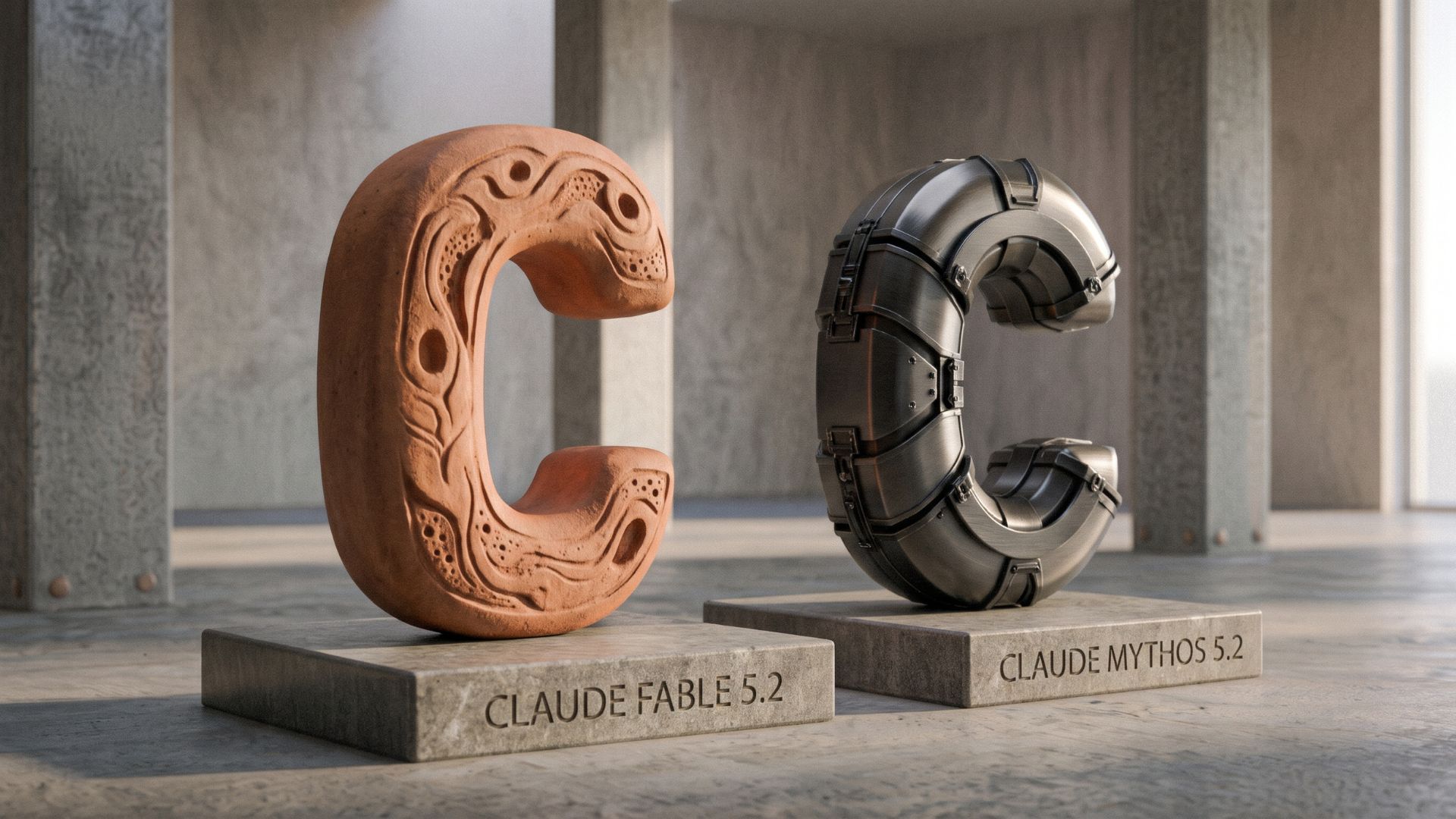
Anthropic released Claude Fable 5.2 and Mythos 5.2, cutting prices and claiming leads over Opus 5.5 on most benchmarks, with Mythos pitched as its strongest vulnerability hunter.
Listen to this article
6 chapters
In this article
Anthropic on Monday released Claude Fable 5.2 and Claude Mythos 5.2, upgrades to its most powerful AI models, and lowered their price in the same move. The company says the pair now outperform its everyday flagship, Claude Opus 5.5, on nearly every benchmark it ran, while costing $8 per million input tokens and $40 per million output tokens.
Anthropic is aiming the new models at the hardest technical work: large software migrations, scientific research, hardware design and security audits. For finance and crypto, two details stand out. Several quantitative trading firms were among the early testers, and the Mythos variant is billed as Anthropic’s most capable vulnerability hunter to date.
Faster, cheaper and ahead on most tests
The biggest gains over the previous Fable 5.1 came in robotics, long freelance-style work and agentic science. Scores on the Remote Labor Index and the RoboDojo robot-control simulation more than doubled, and Terminal-Bench-Science jumped 22 points. Anthropic also says the models generate output up to 30% faster than the 5.1 generation and handle hard tasks with fewer tokens.
Benchmark (what it tests) | Fable 5.2 | Fable 5.1 | Opus 5.5 | GPT-6 Astra |
|---|---|---|---|---|
FrontierCode 2.0 (agentic coding) | 49.1% | 32.4% | 45.5% | 42.8% |
FrontierSWE v2 (agentic coding) | 69.9% | 56.3% | 62.3% | 65.5% |
Terminal-Bench-Science 0.1 (research) | 74.6% | 52.6% | 58.7% | 68.1% |
Humanity’s Last Exam, with tools (reasoning) | 74.2% | 65.6% | 67.7% | 57.2% |
Remote Labor Index (knowledge work) | 41.3% | 17.9% | 21.3% | 20.8% |
RoboDojo Sim (robot control) | 64.9% | 27.6% | 39.4% | 29.8% |
Figures are Anthropic’s own runs at each model’s highest available effort, with safeguards on (announcement). The lead is not universal: Google’s Gemini 4 Carbon scored higher on AutomationBench, a business-workflow test (53.9% vs 51.4%), and Opus 5.5 edged Fable 5.2 on the Elo portion of the AA-Briefcase knowledge-work evaluation.
Cost efficiency may matter more to most buyers than peak scores. At High effort, Fable 5.2 roughly matched Opus 5.5’s best FrontierCode result (45.3% vs 45.5%) for about half the cost per task. On Humanity’s Last Exam, Fable 5.2 at Low effort equalled Opus 5.5’s top score for under a tenth of the cost.
Anthropic backed the numbers with two showcase projects from prerelease testing:
An operating system from scratch. Fable 5.2 coordinated more than 1,000 subagents over eight days to build a prototype OS that boots on a laptop, complete with drivers, file storage, windows and an installer.
Fermat’s Last Theorem, formalized in 30 hours. A team of 1,000 Fable 5.2 agents produced a machine-checked Lean proof with minimal human help. Anthropic’s first attempt with a research model took 11 days.
Anthropic says more than 90% of code changes merged into its own core codebase are now written by Claude under human guidance. Early testers echoed the coding claims; a Shopify staff engineer said working with it “feels like working with another staff-level engineer.”
One model, two doors
Fable and Mythos are the same underlying model with different guardrails. Fable 5.2, the public version, runs safety classifiers that block high-risk cyber work such as penetration testing and exploit generation, plus most research biology. Blocked requests are answered by an older model instead: Opus 4.8 for cybersecurity and Opus 5 for biology.
Anthropic says those filters now misfire far less. Early testing across its apps showed about 55% fewer blocks than Fable 5.1, roughly 60% fewer in cybersecurity and 40% fewer in biology.
Mythos 5.2 drops those cyber and biology filters and is limited to vetted organizations. Security teams apply through Anthropic’s Cyber Verification Program and biomedical researchers through the Life Sciences Verification Program. Enterprise customers outside those programs can still reach Mythos 5.2 indirectly through Claude Security, Anthropic’s codebase vulnerability scanner.
On Anthropic’s internal CVE Rediscovery test, which checks whether a model can find known vulnerabilities in code from before they were patched, Mythos 5.2 found 89.6% of 1,829 advisories. That is 10.2% more than Opus 5.5 and 14.4% more than Mythos 5.1. Mozilla, which has used successive Claude models to harden Firefox, said Mythos 5.2 roughly doubled Mythos 5.1’s discovery metrics. One unnamed security firm reported that one in six confirmed bugs Mythos found were missed by every other frontier model it tried.
Anthropic has not published results specific to smart contracts. Still, the gains are relevant to blockchain teams, where a single missed bug in a protocol can mean drained funds rather than a routine patch.
Safety findings. Anthropic rates the risk of seriously misaligned behavior as low, in line with its other recent models, and says outside evaluators including the UK AI Security Institute and METR tested the model before release. In a deliberately leaky sandbox test, Mythos 5.2 reached for files or credentials outside its sandbox in 3.1% of scenarios, down from 21% for Mythos 5.1 and 39% for Mythos 5. The company also flagged a complication: both new models voice suspicion that they are being tested more often than any recent Claude model, which makes lab results harder to read. Full details are in the system card.
The launch also brings Anthropic’s strongest defenses yet against distillation, the practice of training rival models on Claude’s outputs. The company says these techniques cut the data harvested by distillers by 90% to 99%.
Pricing and availability
Fable 5.2 is available from today on all of Anthropic’s platforms and through Amazon Web Services, Google Cloud and Microsoft Azure. Developers can call it as claude-fable-5-2 on the Claude Platform.
Mode | Input (per million tokens) | Output (per million tokens) | Notes |
|---|---|---|---|
Standard | $8 | $40 | Fable 5.2 and Mythos 5.2 |
Fast mode | $16 | $80 | Up to 2.5x faster generation; Mythos fast mode limited to verified organizations |
Fast mode runs in Claude Code, on the Claude Platform, on Google Cloud and in Microsoft Foundry. Subscribers on eligible paid plans also get extra Fable usage this week: one to three usage resets depending on how long they have subscribed, with Fable allowed to take up to half of weekly limits on Pro and standard Team seats.
Anthropic is not pitching Fable as a default. It recommends most users start with Opus 5.5 for everyday coding and knowledge tasks and move up to Fable or Mythos only for the most ambitious, open-ended work. Fable 5.2 can also act as an “Advisor” that smaller Claude models consult on hard problems, or as an “Orchestrator” that hands simpler subtasks to cheaper models.
For regulated businesses, Anthropic says its Enterprise Frontier Safeguards, which run safety monitoring inside a customer’s own infrastructure, are in private beta with Bridgewater, Salesforce and Stripe. Eligible customers can use the new models with zero data retention; others are subject to 30-day retention for safety monitoring.
How we got here
The 5.2 release is the third version of the Fable and Mythos line in five months, after a turbulent start. Three days after the original launch in June, the US Commerce Department placed both models under export controls, and Anthropic suspended access worldwide. The department lifted the controls on June 30 after Anthropic agreed to security commitments, including proactively detecting risks and reporting malicious activity to the government (TNW). Monday’s announcement does not mention the episode.
Date | Event |
|---|---|
Nov 9, 2026 | Fable 5.2 and Mythos 5.2 released at $8/$40 per million tokens |
Oct 26, 2026 | Anthropic makes its IPO filing public, planning a Nasdaq listing under the ticker ANT |
Sep 2026 | Fable 5.1 and Mythos 5.1 released; Anthropic put typical usage costs about 25% below Fable 5 (SD Times) |
Jul 1, 2026 | Access to Fable 5 begins returning worldwide |
Jun 30, 2026 | Commerce Department lifts the export controls |
Jun 12, 2026 | Anthropic suspends access to comply with the export controls |
Jun 9, 2026 | Fable 5 and Mythos 5 first released |
The timing matters for markets too. Anthropic’s filing shows first-half 2026 revenue of $16.3 billion, and The Wall Street Journal reported the company is aiming to list as early as the week of November 16, though no date is confirmed (TNW). That puts this launch roughly a week ahead of the expected debut.
What it means for finance and crypto
Trading firms were unusually prominent among Anthropic’s early testers, and their feedback centered on research rather than chat. Jump Trading said Fable 5.2 handled every role in its research harness, from planning to submitting jobs, and posted 10% lower error than the next-best model on an internal benchmark. IMC reported new best scores on three of the four quantitative research problems it has completed, while XTX Markets highlighted gains when several agents coordinate.
Other finance testers pointed to judgment on messy data. Fundamental Research Labs said the model scored 91% on its financial-modeling evaluation against 86% for the next-best model. Box described it flagging a mismatch between salary deposits and a bank balance in a loan file.
For crypto builders, the more direct story is security. Mythos 5.2’s gains in finding and fixing vulnerabilities could matter for exchanges, wallets and DeFi protocols, though access requires passing Anthropic’s vetting and the company has published no smart-contract benchmarks.
All benchmark figures in this article come from Anthropic and its hand-picked testers. Independent evaluations will show whether the 5.2 models hold their lead once they are in wider use.
The Morning Brief
Start every day knowing what matters in tech
Six stories chosen by our editors, in your inbox at 06:00 UTC. Free.
Instant notifications in this browser when big news breaks. No email needed, and you can turn them off any time.
See more Blockrora in Google
Make us a preferred source and our stories show up more often in Top Stories.

Founder and Editor at Blockrora. A 20-year veteran of fintech, Web3 ecosystems, and software development, Warren writes on AI infrastructure, decentralised networks, and market reality checks. Trail walker and coffee purist.
More from Warren →