How Bitcoin Accidentally Became an AI Stock
Bitcoin slid to about $76,000 as a chip and AI stock selloff hit the Nasdaq, showing how miners' pivot to AI data centers has tied the cryptocurrency to the tech trade.
Listen to this article
8 chapters

In this article
Bitcoin started this week looking like a winner. It is ending it looking like a tech stock.
On Wednesday, the day after Democrats swept the US midterms, Wall Street rallied hard and Bitcoin climbed back above $80,000. By Thursday afternoon the whole move was gone. A brutal selloff in chip and AI stocks dragged the Nasdaq into correction territory, and Bitcoin slid to around $76,000 alongside it.
Nothing about Bitcoin itself changed in those 48 hours. There was no hack, no ban and no protocol failure. What changed was the market's appetite for AI, and over the past two years Bitcoin has quietly wired itself into that trade through the very companies that secure its network.
Thursday: the AI trade breaks, and Bitcoin breaks with it
The selling on Thursday, November 5 started in Silicon Valley, not in crypto. Investors began reassessing AI spending and the possibility that a Democratic-controlled Congress will put data centers under closer scrutiny. Chipmakers took the first hit, and everything priced off the AI boom followed.
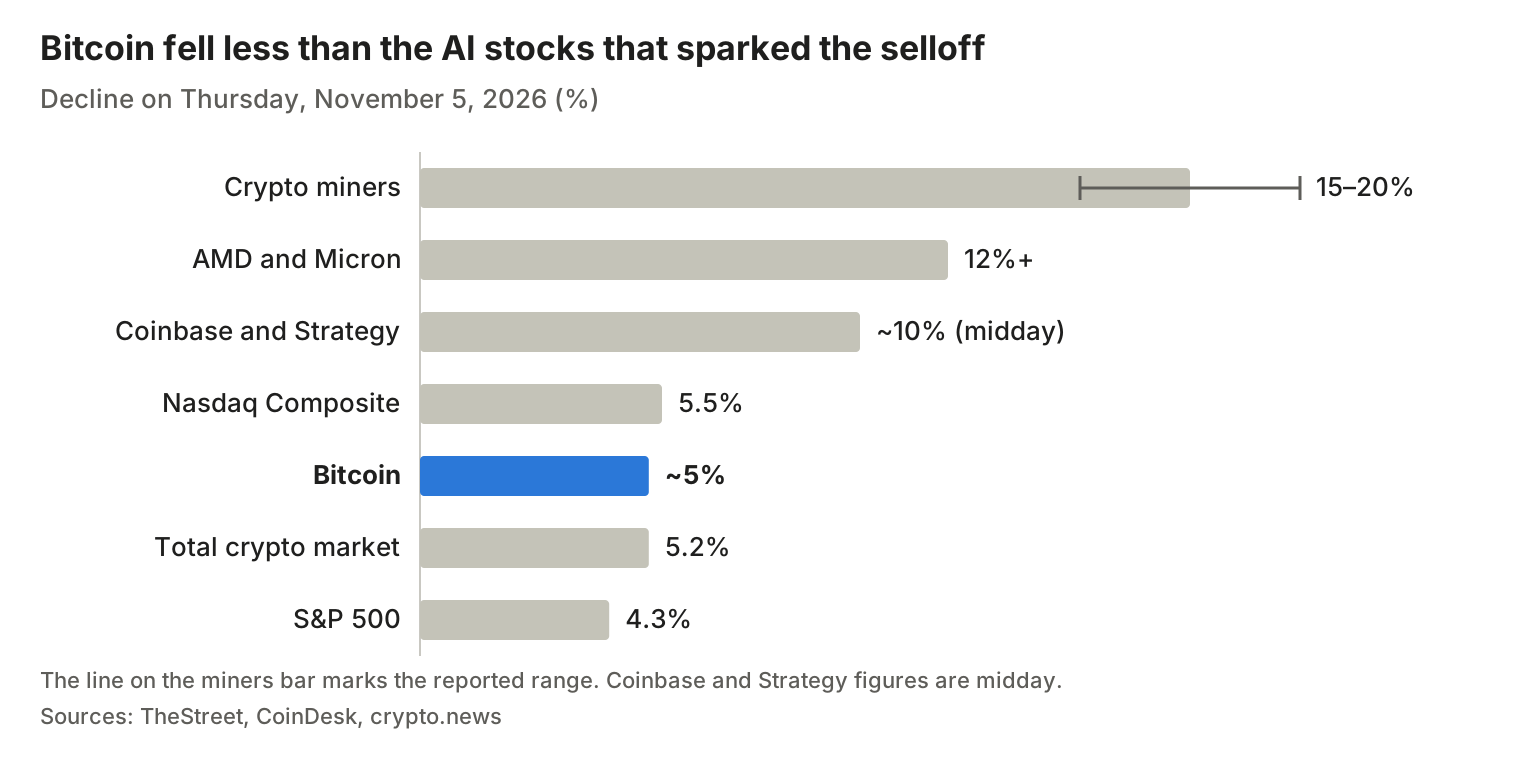
Bitcoin's fall was in line with the Nasdaq's and far smaller than the drops in the AI-linked stocks at the centre of the selloff.
Leverage made it worse. CoinGlass data showed about $1.26 billion in liquidations over 24 hours, and roughly $1.12 billion of that came from traders betting on higher prices. When the floor moves that fast, forced selling does the rest.
The speed is the tell. Bitcoin didn't drift lower on crypto news. It dropped in step with the opening of US stock trading and the collapse in chip shares.
From hashrate to compute: how miners became AI landlords
Bitcoin's biggest public miners now make much of their money renting power to AI companies. They realised they were sitting on exactly what the AI boom is short of: large amounts of secured electricity, in buildings already wired and cooled for dense computing.
The deals are enormous. By June, public miners had announced more than $70 billion in AI and high-performance computing contracts, according to a crypto.news analysis. Hut 8 signed a 15-year, $9.8 billion lease for a 352-megawatt site in Texas. IREN signed a $9.7 billion deal with Microsoft covering 76,000 Nvidia GPUs, and TeraWulf has $12.8 billion in contracted AI revenue.
The logic is hard to argue with. Mining is a commodity business whose reward gets cut in half every four years, while a 15-year lease to a blue-chip AI tenant is steady, dollar-denominated cash flow. Investors agreed: early in 2026, a basket of mining stocks rose about 56% while Bitcoin fell about 17%.
The pivot came with two strings attached. Miners took on heavy debt to build to hyperscaler standards, with TeraWulf alone carrying about $5.7 billion. They also paid for part of it by selling Bitcoin, cutting their combined treasuries by more than 15,000 BTC from peak levels.
Why a Democratic Congress spooked Bitcoin
The election mattered because data centers have become a political fight. Rising electricity bills have turned them into a target, and the loudest opposition comes from Democrats. Senator Bernie Sanders and Representative Alexandria Ocasio-Cortez have already put forward a bill to pause new AI data-center construction until Congress writes national rules.
With Democrats now in control of both chambers, traders started pricing that risk in, on top of lacklustre chipmaker earnings, as Bloomberg noted. According to CoinDesk, analysts at FalconX and GSR linked the slide to fears of a slower AI buildout, and crypto miners fell 15% to 20%.
This is where Bitcoin gets pulled in. Miner stocks are now the bridge between Wall Street's AI trade and the crypto market, and when that bridge sways, Bitcoin feels it twice. First through sentiment, and second through the risk that miners sell more coins to keep expensive data-center plans funded.
There is an irony here. Bitcoin mining's best argument with regulators has always been its flexible load, because it can switch off when the grid is under strain. AI workloads can't, and the industry spent two years becoming more like the thing politicians now want to slow down.
The digital gold problem
On Thursday, gold did what Bitcoin's believers always said Bitcoin would do. It edged higher while risk assets fell, trading around $4,094 an ounce as Bitcoin lost more than 5%, according to CoinDesk.
That pattern isn't new. Bitcoin is still roughly 40% below its October 2025 record of about $126,000, and for most of this year it has traded like a high-octane tech asset rather than a haven.
The AI story explains part of the reason. When the companies securing the network are valued like AI infrastructure, and the funds holding Bitcoin also hold the Nasdaq, Bitcoin will move with tech on the days tech breaks. The digital gold thesis isn't dead, but it isn't what the market is trading right now.
The glass-half-full case
Look closely and Bitcoin held up better than the stocks that started the fire. It fell about 5% on Thursday, while AMD and Micron dropped more than 12% and crypto miners lost 15% to 20%. By Friday morning it was back above $76,000, according to crypto.news.
Not everyone read Thursday as a turning point. Wintermute's Jasper De Maere cautioned against reading too much into a single day's selloff, CoinDesk reported. Trader Michaël van de Poppe noted that Bitcoin had a milder day than the Nasdaq, and suggested both could find a floor soon.
The longer view is less grim than the headlines, too. Even at February's low near $60,000, Bitcoin's fall from its peak was far shallower than the 75% to 85% collapses of earlier crypto winters, as LeverageShares pointed out.
There is also a quieter upside to the miner pivot. Miners with long-term AI leases have steadier cash flow, so in theory they're less likely to be forced to dump coins every time the price drops. That could make future selloffs less violent, even if this one hurt.
What to watch next
If Bitcoin is trading as part of the AI complex, the signals to watch sit on both sides of that bridge.
Key price levels. Analysts cited by crypto.news see support near $75,300 and then $72,000, with resistance around $77,900 and $80,000. CryptoQuant's Darkfost flagged $70,000 as an area where many holders' cost bases cluster.
ETF flows. US spot Bitcoin ETFs lost $430.2 million on November 5, with Fidelity's fund leading at $199.9 million. That took November outflows to about $869.8 million in four sessions, per Farside data.
Spot demand. CryptoQuant data shows selling volume has overtaken buying on Binance and Coinbase. A real recovery needs that to flip.
Data-center policy. Watch federal and state moves to pause or restrict new data centers. Every headline here now lands on miners first, then on Bitcoin.
AI earnings and spending. If big tech keeps signalling heavy AI investment, the bridge steadies. If the AI trade keeps unwinding, Bitcoin will probably feel it again.
Crypto legislation. The CLARITY Act market-structure bill is racing the clock before the new Congress is seated in January, as TheStreet reported.
The bottom line
Bitcoin didn't break this week. The AI trade did, and Bitcoin was standing too close to it.
Through its miners, its ETF holders and its traders, Bitcoin is now wired into the same flows of money as the Nasdaq. Until that changes, the question isn't only what happens to Bitcoin. It's also what happens to AI.
For long-term holders, that's worth understanding rather than fearing. Bitcoin's code, supply and network didn't change on Thursday. What changed is who owns the infrastructure around it, and what else that infrastructure is now exposed to.
This article is for information only and is not financial advice.
The Morning Brief
Start every day knowing what matters in tech
Six stories chosen by our editors, in your inbox at 06:00 UTC. Free.
Instant notifications in this browser when big news breaks. No email needed, and you can turn them off any time.
See more Blockrora in Google
Make us a preferred source and our stories show up more often in Top Stories.

Founder and Editor at Blockrora. A 20-year veteran of fintech, Web3 ecosystems, and software development, Warren writes on AI infrastructure, decentralised networks, and market reality checks. Trail walker and coffee purist.
More from Warren →